
Landlord Operations: How to Manage a Rental Property
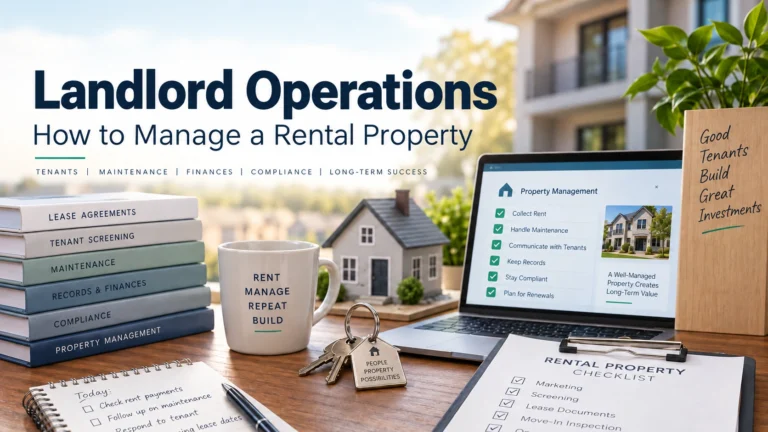
Buying a rental property is only the beginning. Once a tenant moves in, the investment becomes an operating business with recurring responsibilities: collecting rent, handling maintenance, communicating with tenants, keeping records, managing vendors, staying on top of compliance requirements, and preparing for renewals or turnover.
Learning how to manage a rental property means building systems that make those responsibilities predictable.
A landlord does not need to personally perform every task. You can self-manage, outsource selected functions, or hire a professional property manager. But regardless of who performs the work, the owner still needs to understand how the operating system fits together.
This guide explains that system from the landlord’s perspective.
It focuses on long-term residential rental operations in the United States. Exact rules for leases, notices, security deposits, property access, repairs, rent increases, late fees, eviction, licensing and other landlord-tenant matters vary by state and locality. Verify the rules that apply where your property is located before acting on a legal or compliance issue.
How to Manage a Rental Property: What the Job Actually Involves
Rental property management is the ongoing process of operating a property after acquisition. For a landlord, that normally means coordinating five connected functions:
Tenant operations: marketing vacancies, processing applications, starting tenancies, communicating with residents, handling renewals and managing move-outs.
Property operations: preventive maintenance, repairs, inspections, vendor coordination and turnover preparation.
Financial operations: collecting rent, paying property expenses, reviewing operating performance and maintaining financial records.
Compliance operations: following applicable federal, state and local requirements and maintaining supporting documentation.
Management oversight: deciding what you will handle yourself, what to outsource and whether professional property management is justified.
Good landlord operations turn these responsibilities into repeatable processes rather than a series of emergencies.
The Landlord Operations Map
A long-term rental moves through a recurring operating cycle.
| Operating Stage | Main Landlord Question | Core Output |
|---|---|---|
| Set up operations | How will this property be run? | Accounts, documents, contacts, policies and systems |
| Prepare for tenancy | Is the property ready to rent? | Rent-ready unit and leasing process |
| Market and screen | How will applicants be handled consistently? | Qualified applicant and documented process |
| Start the tenancy | What needs to happen before and at move-in? | Executed lease, disclosures and move-in records |
| Operate the tenancy | How will rent, communication and requests be handled? | Repeatable monthly operations |
| Maintain the asset | How will issues be prevented, identified and resolved? | Maintenance and vendor system |
| Control records and finances | Can the owner reconstruct what happened? | Complete financial and operating records |
| Renew or turn over | What happens as the lease approaches its end? | Renewal, move-out or turnover decision |
| Review the management model | Is the current management approach still efficient? | Self-manage, hybrid or outsource decision |
The important point is that these stages connect.
A weak tenant-selection process can create collection and turnover problems. Poor documentation can complicate disputes or tax preparation. Deferred maintenance can affect tenant retention and property performance. Poor communication can turn manageable issues into larger ones.
Landlord operations work best when the entire lifecycle is treated as one system.
1. Build the Operating System Before You Need It
A common mistake is waiting for something to happen before deciding how it will be handled. The better approach is to define recurring processes before the property becomes busy.
At minimum, the operating system should establish how you will handle rent, tenant communication, maintenance requests, emergencies, vendors, documents and financial records. That does not require complicated software.
A landlord with one property may use relatively simple systems. An owner with twenty units may need dedicated property-management software, bookkeeping workflows, automated communications and formal vendor processes.
The underlying functions, however, are similar.
Separate rental activity from personal activity
Create a clear system for tracking money associated with the rental. That means being able to distinguish rental income and property expenses from your personal finances.
The IRS guidance on rental income, deductions and record keeping emphasizes maintaining records that support rental income and expenses. Good records also help owners monitor the performance of the property, prepare financial statements and substantiate amounts reported on tax returns.
Your tax and accounting structure will depend on your circumstances, so recordkeeping should support, and not replace professional tax advice where needed.
Create one place for property records
A rental property produces documents continuously. Examples include the lease, applications, inspection records, invoices, receipts, insurance documents, warranties, correspondence, notices and maintenance records.
Use a consistent filing system so information can be found later. The specific system matters less than consistency.
Establish communication channels
Decide how tenants should contact you for routine questions, maintenance requests and urgent issues. Clear communication reduces confusion about where a request should go and creates a better documentation trail.
For example, routine maintenance might use an online portal or designated email address, while an urgent property issue may have a different contact procedure.
Do not invent a universal definition of a legally required response time. Repair and notice obligations vary by jurisdiction and circumstances.
Instead, establish an internal escalation process and verify the legal requirements where the property is located.
Build your vendor list before an emergency
Waiting until water is entering a property to find a plumber is not a strong maintenance system. Maintain current contact information for the trades and services your property may require.
Depending on the asset, that could include plumbing, HVAC, electrical, general maintenance, roofing, pest control, landscaping, cleaning, locksmith and appliance service.
The objective is not to build a huge contractor database. It is to know who you can call when a predictable property issue occurs.
2. Decide How the Property Will Be Managed
There is no single correct management model for every landlord. The practical options generally fall into three categories.
| Management Model | Owner Involvement | Potential Advantage | Main Tradeoff |
|---|---|---|---|
| Self-management | High | Direct control and no full-service management arrangement | Requires time, systems and operating discipline |
| Hybrid management | Medium | Owner keeps selected functions while outsourcing others | Responsibilities must be clearly divided |
| Professional management | Lower day-to-day involvement | Operational work can be delegated | Management cost and reduced direct control |
Self-management can make sense when the owner has enough time, suitable systems, appropriate knowledge and a property that can be managed efficiently.
A hybrid model might mean the owner manages leasing and finances but uses contractors for maintenance, or handles major decisions while outsourcing selected administrative tasks.
Professional management may become more attractive when the owner lacks time, lives far from the property, owns more units, has a complicated asset, or simply does not want to handle daily landlord responsibilities. How to manage a rental property effectively also depends on choosing the right level of owner involvement. The decision should not be based on management fees alone.
Ask what management demands from you, what your time is worth, which functions create the most friction, and whether outsourcing would improve the operating result.
The right management model depends on your time, experience, property location, portfolio size, and how involved you want to be in day-to-day operations. Whether you self-manage, outsource selected tasks, or hire a professional property manager, choose the approach deliberately rather than becoming a self-manager by default.
3. Prepare the Rental Before Marketing It
Operating problems often begin before the first application arrives. Before offering a unit for rent, determine whether the property is physically ready, whether required information and disclosures have been prepared, and whether your leasing workflow is defined.
That normally means reviewing the property’s condition, confirming essential systems are working, completing planned turnover work, preparing marketing information and establishing the process applicants will follow.
Treat disclosures as a compliance step
Some disclosures are governed by federal law, while others depend on state or local requirements. One important federal example involves lead-based paint.
For most housing built before 1978, the EPA’s Lead-Based Paint Disclosure Rule guidance requires landlords and other covered parties to provide specified information about known lead-based paint and lead hazards before a prospective tenant becomes obligated under a lease. EPA identifies exceptions, so the rule should be applied based on the actual property and transaction rather than assumed universally.
State and local law may impose additional disclosures. Build disclosure review into the leasing workflow rather than treating it as an afterthought.
4. Market the Property and Handle Applicants Consistently
Tenant acquisition is one of the most consequential parts of rental operations. A documented, consistently applied process helps you handle applicants more fairly, consistently and efficiently.
That process may include defining lawful qualification criteria, accepting applications, verifying information, obtaining permitted reports and documenting decisions.
Fair housing applies to rental operations
The federal Fair Housing Act prohibits housing discrimination based on race, color, national origin, religion, sex, familial status and disability. State and local laws may protect additional classes.
A landlord should therefore avoid improvising applicant criteria from one person to another.
Consistent written processes can help reduce arbitrary decision-making, although written criteria themselves still need to comply with applicable law.
Consumer reports create additional responsibilities
Tenant background reports supplied by screening companies may qualify as consumer reports under the Fair Credit Reporting Act.
The FTC’s guidance for landlords using consumer reports explains that landlords who use consumer reports in housing decisions have FCRA responsibilities, including requirements associated with obtaining reports and providing notice when adverse action is based partly or completely on information in a consumer report.
A practical screening rule is:
Use a defined screening workflow, apply it consistently, understand the information you are using, and verify federal, state and local requirements before making applicant decisions.
5. Start the Tenancy With Documentation
Move-in is where the operating plan becomes a real landlord-tenant relationship. A rushed move-in can create uncertainty that follows the property for months.
Before or at the start of the tenancy, make sure the required lease documents and disclosures are completed, payment arrangements are clear, contact information is exchanged and the property’s condition is documented according to your process and applicable law.
Make expectations operational
The lease is a legal document, but day-to-day management also depends on practical expectations.
Tenants should know how to:
- pay rent;
- report maintenance;
- communicate routine questions;
- report urgent property issues;
- use any relevant property systems; and
- locate important contact information.
You do not need a thick operations manual for every rental. You do need enough clarity that the tenant is not guessing how the property is managed.
Document property condition
A condition record can help establish what the property looked like when the tenancy began.
The exact move-in documentation requirements and how they relate to security deposits vary by jurisdiction.
Whatever process applies, complete it systematically and retain the records.
6. Create a Predictable Rent-Collection Process
Rent collection should be a process, not a monthly negotiation. The lease and applicable law should establish when rent is due and what happens when obligations are not met.
Operationally, the landlord needs a reliable way to:
- receive payments;
- identify whether payment was received;
- document the transaction;
- reconcile the payment with property records; and
- address exceptions according to the lease and applicable law.
Automation can reduce administrative effort, but software does not eliminate the need for oversight. Review payments and reconcile your records regularly.
Avoid making up rules when rent is late
Late fees, notice requirements, grace periods and enforcement procedures may be regulated by state or local law.
Do not assume that a procedure used by another landlord or found in a generic lease is valid for your property.
Your operating system should distinguish between the process you prefer and the process the law allows or requires.
When rent is late, follow the lease and the applicable legal procedure rather than creating an improvised response.
7. Treat Tenant Communication as an Operating Function
Landlord communication is not simply customer service. It creates information that may later matter for maintenance, payment records, lease administration or disputes.
That makes consistency important. Routine communication should be clear, professional and documented appropriately.
A simple rule helps: Important property decisions should not exist only in someone’s memory.
If a conversation changes an agreed arrangement or creates an action item, document it using an appropriate method.
At the same time, avoid unnecessary communication systems that make a small rental operation difficult to manage.
The goal is a reliable record, not bureaucracy.
8. Build Maintenance Around Prevention, Response and Documentation
Maintenance is one of the largest recurring operating responsibilities for a landlord. The strongest maintenance systems do three things:
- prevent predictable problems where practical;
- respond to issues when they arise; and
- document what happened.
Preventive maintenance may include servicing systems, checking known wear items and addressing small issues before they become more expensive.
Reactive maintenance handles repairs reported by tenants or discovered by the owner or service providers. Documentation records the request, response, work performed and relevant invoices or follow-up.
Create an escalation framework
Not every maintenance request has the same urgency. A cosmetic issue does not require the same operating response as active water intrusion, loss of a critical building system or an immediate safety concern.
Rather than publishing universal response deadlines, which may be wrong for a particular jurisdiction, create an internal triage process:
| Operating Level | Typical Approach |
|---|---|
| Routine | Record, prioritize and schedule |
| Time-sensitive | Escalate and coordinate prompt service |
| Potential emergency | Use the property’s emergency process and appropriate emergency/service resources |
Legal requirements may impose specific duties or timelines. Check the rules governing the property’s jurisdiction. For your own operating system, document recurring preventive tasks, trusted vendors, repair history and follow-up so maintenance does not depend on memory.
9. Use Inspections as an Asset-Management Tool
Property inspections can help landlords identify deferred maintenance, verify property condition and plan future work. But an owner does not have unlimited access to an occupied rental.
Notice requirements, permitted reasons for entry and other restrictions vary by state and locality and may also be addressed in the lease.
Build inspection planning around the rules that apply to the property.
Operationally, the useful questions are:
- What condition should be documented?
- What maintenance should be scheduled?
- What follow-up work is required?
- What records should be retained?
- When is the next appropriate review?
The goal is not to search for minor tenant mistakes. It is to operate and preserve the property responsibly.
10. Keep Financial and Property Records Together
A landlord should be able to reconstruct the financial and operating history of a rental.
If you cannot explain where money came from, what it was spent on, what maintenance occurred or what important tenancy decisions were made, the operating system is incomplete.
The IRS rental-property recordkeeping guidance notes that good rental records help owners monitor property performance, prepare financial statements, identify receipts, track deductible expenses, prepare tax returns and support items reported on those returns.
IRS Publication 527 also explains that rental income can include more than ordinary monthly rent and discusses common categories of rental expenses. Tax treatment depends on the facts, so accounting records should preserve the underlying transactions rather than relying on assumptions about deductibility.
A practical documentation matrix
| Record Type | Examples | Why It Matters Operationally |
|---|---|---|
| Tenant records | Applications, lease, notices, correspondence | Tenancy administration |
| Property condition | Inspection notes, photos, turnover records | Condition history and maintenance |
| Income | Rent and other property receipts | Reconciliation and reporting |
| Expenses | Invoices, receipts, vendor payments | Cost control and tax records |
| Maintenance | Requests, work orders, contractor records | Repair history and follow-up |
| Compliance | Required disclosures and related documents | Evidence that required processes were addressed |
| Asset documents | Insurance, warranties, major improvement records | Property and capital planning |
Retention requirements can depend on the document and applicable law. Use professional tax or legal guidance where specific retention periods matter.
11. Manage Renewals Before the Lease Ends
Lease expiration should not come as a surprise. Use a calendar or management system to identify upcoming lease events early enough to make deliberate decisions.
The exact notice requirements vary by jurisdiction and lease terms, but the operational decision usually begins with questions such as:
- Is the tenant relationship functioning well?
- Is the property being maintained appropriately?
- What is the current rental-market context?
- Are there planned property changes?
- Does applicable law affect renewal or rent-adjustment options?
- What notice or documentation is required?
Do not wait until the final days of a tenancy to start answering these questions. A predictable renewal process reduces rushed decisions.
12. Build a Repeatable Move-Out and Turnover Process
When a tenancy ends, the property enters another operating phase.
The landlord may need to coordinate notice documentation, access, condition review, security-deposit procedures, cleaning, repairs, maintenance and preparation for the next tenant.
Security-deposit handling is particularly jurisdiction-sensitive.
Rules can govern allowable deductions, accounting requirements, deadlines, required notices and where deposits must be held.
Do not use a generic national timeline. Follow the law that applies to the property’s location and the actual tenancy.
From an operating perspective, every turnover should answer four questions:
- What happened during the tenancy?
- What work is required now?
- What should be improved before the next tenancy?
- What did this turnover teach us about the operating system?
That final question matters. Repeated damage, recurring maintenance issues, poor documentation or unusually long vacancy periods may reveal a process problem rather than just an unlucky event.
13. Give the Property an Operating Cadence
Many landlord responsibilities become easier when they have a regular review rhythm. Not every item needs to happen monthly. Some are event-driven, seasonal or annual.
| Cadence | Examples of Operational Review |
|---|---|
| Event-driven | Applications, lease signing, repair requests, payment exceptions, move-in and move-out |
| Monthly | Rent reconciliation, unresolved requests, upcoming lease events, property expenses |
| Periodic | Preventive maintenance, vendor review, property-condition review |
| Seasonal | Weather-related maintenance and asset-specific preparation |
| Annual | Insurance review, tax-document preparation, larger maintenance planning, management-model review |
| Turnover | Condition, repairs, records, leasing preparation and process review |
The cadence should match the property. A single-family rental in one climate may require different recurring work from a small multifamily building in another.
The operating principle is to put recurring responsibilities on a system instead of relying on memory.
14. Monitor Operating Health, Not Just Whether Rent Arrived
A rental can collect rent every month and still develop operational problems. Create a simple landlord dashboard that highlights issues before they become larger.
You do not need sophisticated analytics for one property. Track signals that help answer whether the property is operating as intended.
| Operating Signal | Question It Helps Answer |
|---|---|
| Occupancy/vacancy | Is the property producing usable rental time? |
| Rent status | Are payments arriving as expected? |
| Delinquency | Are payment problems becoming recurring? |
| Open maintenance items | Are unresolved property issues accumulating? |
| Repair frequency | Are particular systems failing repeatedly? |
| Upcoming lease events | Are renewals or turnovers being anticipated? |
| Turnover duration | How efficiently is the property returning to rent-ready condition? |
| Operating expenses | Are costs changing materially? |
| Record completeness | Could you substantiate important transactions and decisions? |
| Compliance tasks | Are required or jurisdiction-specific items being missed? |
This is an operating dashboard, not a substitute for investment underwriting.
Metrics such as NOI, cap rate, DSCR, and cash-on-cash return help you evaluate a property’s financial performance. For a deeper look at how these metrics work together, see our Real Estate Deal Analysis guide. Accurate landlord records and operating data make that analysis more reliable.
15. Know When Your Management System Is Breaking
Landlords often look for a property manager only after they are overwhelmed. It is better to recognize capacity problems earlier.
Warning signs can include unresolved maintenance accumulating, poor recordkeeping, repeated missed communications, increasing difficulty coordinating vendors, late responses to important issues, inconsistent tenant processes or simply too much owner time being consumed by daily operations.
Growth can also change the decision. A system that works for one nearby property may become inefficient with several units across multiple locations.
As the portfolio grows, use Real Estate Portfolio Management to evaluate whether operating capacity, management structure, liquidity, concentration, and future growth remain aligned across all properties.
Before outsourcing, identify the actual bottleneck. If maintenance coordination is the problem, you may need better vendor systems rather than full-service management.
If leasing is consuming too much time, outsourcing leasing may be enough. If the owner no longer wants operational responsibility, full-service management may be the cleaner solution.
This is why a hybrid model can sometimes make sense.
The question is not merely “Can I self-manage?” It is “What management structure gives this property a reliable operating system at an acceptable cost and level of owner involvement?”
Common Landlord Operations Mistakes
The same management failures tend to create problems across otherwise different rental properties.
Operating reactively
If every maintenance request, renewal and payment issue creates a brand-new process, management becomes harder as the portfolio grows. Build repeatable workflows.
Using inconsistent tenant processes
Changing criteria or procedures unpredictably creates operational confusion and can create compliance risk. Use defined processes and verify applicable housing laws.
Keeping poor records
Memory is not a document-management system.
Retain the records needed to understand financial activity, property condition, communications and important tenancy events.
Ignoring small maintenance problems
Some inexpensive problems become expensive when neglected. A maintenance system should make follow-up visible.
Treating every issue as equally urgent
A broken cosmetic fixture and an active water leak should not enter the same operating queue.
Use a triage process.
Copying another landlord’s legal procedures
A lease form, security-deposit practice, late-fee policy or entry procedure used elsewhere may not comply with the law governing your property. Verify jurisdiction-specific requirements.
Focusing only on management fees
The lowest-cost management model is not necessarily the best operational model. Consider time, reliability, oversight, tenant experience, asset protection and scalability.
Automating without oversight
Software can collect payments, store documents and route maintenance requests. It cannot remove the owner’s responsibility to understand what is happening with the property.
Automation should make oversight easier, not replace it.
Where to Go Next
Use these related guides when you need to move from day-to-day rental operations into investing decisions or deeper property analysis.
| If You Need To… | Best Next Topic |
|---|---|
| Understand the broader rental-investing model | Rental Property Investing |
| Evaluate a property’s financial performance | Real Estate Deal Analysis |
| Understand rental income, deductions, depreciation, and investor tax issues | Real Estate Investing Taxes |
| Compare investment approaches | Real Estate Investment Strategies |
| Learn the first-property acquisition process | How to Buy Your First Rental Property |
| Decide whether to manage personally or outsource | Self-Manage vs Property Manager |
| Build a compliant applicant process | Tenant Screening Checklist / How to Screen Tenants |
| Build a stronger repair and preventive-maintenance system | Rental Property Maintenance |
| Understand professional-management pricing | Property Management Fees |
The linked guides above are available now. The remaining topics highlight useful areas to explore as you build a more complete rental-management system.
Frequently Asked Questions
What does a landlord need to manage a rental property?
At a minimum, a landlord needs systems for tenant communication, rent collection, property maintenance, financial and document records, recurring lease events and applicable compliance obligations. The exact tools can be simple for a small portfolio, but the underlying responsibilities still need to be covered.
Is it hard to manage a rental property yourself?
It depends on the property, the owner’s experience, location, available time and complexity of the tenancy. A single nearby property with good systems may be manageable for one owner, while another landlord may prefer professional management even with one unit. The more useful question is whether the owner can operate the property reliably and consistently.
Should I self-manage or hire a property manager?
Compare the work required with your time, operating skills, distance from the property, portfolio size and the cost and quality of available management services. Full-service management is not the only alternative to self-management; selective outsourcing and hybrid models are also possible.
What are the main responsibilities of a landlord?
At a broad operational level, landlords coordinate leasing, tenant communication, rent collection, property maintenance, recordkeeping, compliance-related processes, renewals and turnovers. Specific legal responsibilities vary by jurisdiction and property type.
How much time does managing a rental property take?
There is no reliable universal number. Workload depends on the property, tenant turnover, maintenance needs, management systems, location and whether functions are outsourced. Management can also be uneven: some months may require little attention while a turnover or major repair requires substantially more.
What records should a rental property owner keep?
Records commonly include rental income and expense documentation, leases, tenant-related records, maintenance documentation, invoices, receipts, inspection or condition records and relevant compliance documents. The IRS specifically emphasizes maintaining records that substantiate rental income and expenses. Specific legal retention requirements may vary.
Can a landlord use a tenant background check?
Landlords may use consumer reports for housing decisions when they have a permissible purpose, but using those reports brings Fair Credit Reporting Act obligations. The FTC explains requirements related to obtaining consumer reports and providing adverse-action notices when report information contributes to an unfavorable housing decision. Fair-housing and state/local requirements may also apply.
How often should a landlord inspect a rental property?
There is no universal inspection frequency appropriate for every rental. Inspection practices should account for the property, legitimate operating needs, lease provisions and applicable state or local rules governing notice and entry.
What is the most important part of rental property management?
No single task controls the entire operation. Strong management comes from connecting tenant processes, maintenance, finances, documentation and compliance into one repeatable system. Weakness in one function can create problems elsewhere.
Conclusion
Managing a rental property is not one task. It is an operating system.
A well-run rental has defined processes for tenants, rent, maintenance, records, compliance, renewals and turnovers. Those processes do not have to be complicated, but they should be deliberate enough that important responsibilities do not depend on memory or last-minute decisions.
Start by defining who handles each function, how information is recorded, how recurring tasks are reviewed and when an issue should be escalated.
Then improve the system as the property and eventually the portfolio grows. As you learn how to manage a rental property more efficiently, the goal is to make recurring responsibilities easier to see, document and repeat.
The objective is not to eliminate every unexpected problem. Rental properties will still need repairs, tenants will still move, and rules will still vary by jurisdiction.
The objective is to make normal operations repeatable, important information visible, and decisions easier to manage. That is the foundation of effective landlord operations.