
Commercial Real Estate Investing: How to Evaluate and Buy CRE
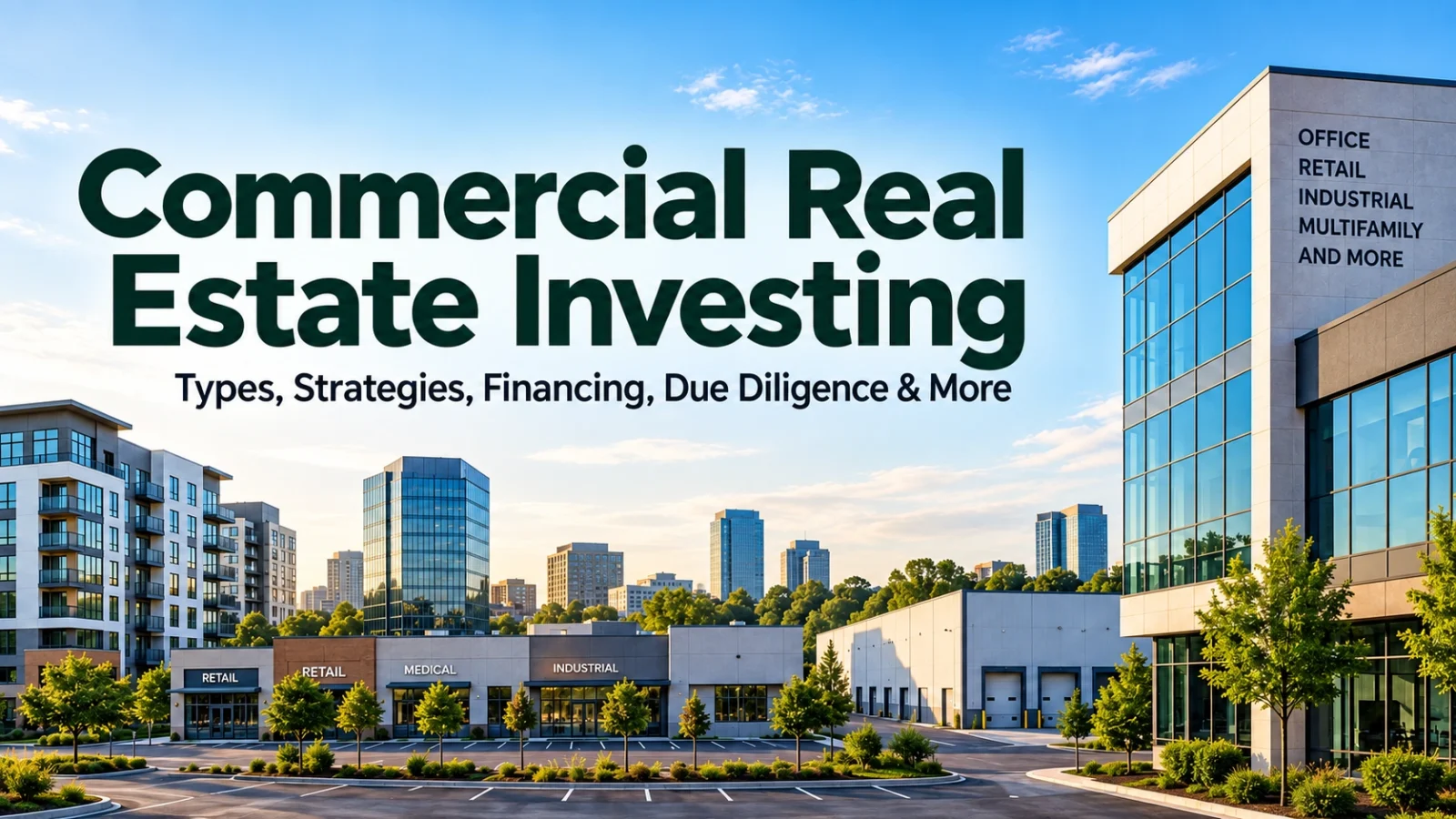
Commercial real estate investing involves buying or allocating capital to properties used primarily to produce income through business, residential, storage, hospitality, industrial, or other commercial activity.
That sounds simple, but commercial real estate is not one uniform investment category.
An apartment building with 80 units, a neighborhood shopping center, a warehouse, a medical office building, a self-storage facility, and a hotel can all fall within the commercial real estate universe while producing income in very different ways. Their leases, tenant risks, operating expenses, financing, capital needs, management demands, and exit markets can differ substantially.
That is why the right starting point is not to ask whether commercial real estate is “better” than residential property.
The better question is: “What type of commercial property are you evaluating, how does that property make money, what could interrupt that income, and what must happen for the investment to meet your objectives?”
This guide explains how commercial real estate investing works, how major property types differ, what numbers and lease terms matter, how to approach due diligence, and how to separate stabilized commercial ownership from financing, passive investing, and development.
If you are still building your overall investing framework, start with our guide to real estate investing.
What Is Commercial Real Estate Investing?
Commercial real estate investing generally means committing capital to property whose value and investment performance are driven primarily by income, business use, lease economics, operating performance, or a combination of those factors.
Commercial investments can include:
- multifamily properties with five or more units;
- office buildings;
- industrial and logistics facilities;
- retail centers;
- self-storage;
- hotels and other hospitality properties;
- medical office;
- mixed-use properties;
- mobile-home and RV communities;
- student and senior housing;
- build-to-rent communities;
- data centers;
- parking facilities;
- certain agricultural, timberland, and other specialized assets.
The category is broad because each property type has its own operating model.
An office property may depend heavily on lease expirations, tenant credit, tenant improvements, and leasing commissions.
An industrial property may depend on transportation access, clear height, loading capacity, power, and the adaptability of the building for future users.
A hotel behaves more like an operating business because occupancy and room rates can change daily.
A multifamily property has shorter leases and more frequent tenant turnover, but may spread income across many households.
The Office of the Comptroller of the Currency’s current Commercial Real Estate Lending handbook emphasizes that commercial property performance varies by property type, geographic market, local economic conditions, leases, and borrower execution.
For an investor, the practical lesson is straightforward:
Commercial real estate should be analyzed property type by property type, not as one generic asset class.
Commercial Real Estate vs Residential Investment Property
Residential and commercial properties can both produce rental income, but the way they are evaluated and operated can differ materially.
| Factor | Residential Investment Property | Commercial Real Estate |
|---|---|---|
| Typical property | Single-family, condo, 2-4 unit residential | 5+ multifamily, office, industrial, retail, storage, hospitality, and other commercial assets |
| Tenant base | Households | Households, businesses, institutions, travelers, or specialized users |
| Lease structure | Usually simpler | Often more negotiated and property-type specific |
| Lease length | Often shorter | Can range from short stays to multi-year commercial leases |
| Valuation emphasis | Comparable sales and rental economics | Often places greater emphasis on property income and market capitalization |
| Financing | Residential/investor products may apply | Commercial and multifamily lending structures are common |
| Capital needs | Often property-level repairs and reserves | Can include large roofs, HVAC, parking, elevators, tenant improvements, leasing commissions, and specialized systems |
| Management | Property management | Property management plus asset-management decisions can be more prominent |
| Exit market | Homebuyers and investors may both matter | Primarily investors, owner-users, funds, institutions, or developers depending on property type |
The distinction becomes especially important with multifamily property.
For Fannie Mae multifamily financing, an eligible multifamily property must contain at least five dwelling units, according to the current Fannie Mae Multifamily Guide.
That does not mean every law, lender, tax rule, or local code uses one universal five-unit definition for every purpose.
It does mean that once an apartment property reaches five or more units, investors commonly encounter the underwriting, financing, and operating framework associated with commercial multifamily property.
For 1-4 unit rental-property investing, continue with rental property investing.
Main Types of Commercial Real Estate
Understanding the property type is the first step because the asset class affects the lease structure, operating model, demand drivers, capital requirements, and buyer pool.
Multifamily, 5+ Units
Commercial multifamily includes apartment properties with five or more dwelling units for the purposes of major multifamily lending programs such as Fannie Mae’s.
Income is usually diversified across many households rather than depending on one business tenant.
Important considerations can include:
- unit mix;
- occupancy;
- effective rents;
- concessions;
- bad debt;
- turnover;
- utilities;
- payroll;
- repairs and maintenance;
- property taxes;
- insurance;
- replacement reserves;
- management quality.
Multifamily can appear operationally familiar to a residential landlord, but larger properties are usually evaluated more directly as income-producing businesses.
Office
Office properties range from small suburban buildings to large central business district towers, medical-adjacent office, and specialized professional space.
Important variables can include:
- tenant credit;
- lease expiration schedule;
- vacancy;
- rent concessions;
- tenant improvements;
- leasing commissions;
- parking;
- building systems;
- floorplate flexibility;
- local employment demand.
Long leases can provide income visibility, but they can also create concentration risk if a major tenant occupies a large portion of the property and later leaves.
Industrial and Logistics
Industrial real estate can include:
- warehouses;
- distribution centers;
- light manufacturing;
- flex buildings;
- research and development space;
- specialized production facilities.
The OCC notes that industrial underwriting can depend heavily on transportation access, building configuration, truck access, power, and whether the property can adapt to other users.
An industrial building designed around one highly specialized tenant may be harder to re-lease than a flexible warehouse in a strong logistics corridor.
Retail
Retail properties can include:
- neighborhood centers;
- grocery-anchored centers;
- power centers;
- malls;
- strip centers;
- freestanding retail buildings.
Retail investing often requires close attention to:
- tenant sales strength;
- anchor tenants;
- co-tenancy provisions;
- traffic and visibility;
- competing retail supply;
- lease reimbursements;
- tenant mix;
- rollover timing.
One tenant’s closure can sometimes affect other leases or the attractiveness of the center.
Self-Storage
Self-storage can generate income from many small rental agreements rather than a handful of long-term commercial tenants. Important factors can include:
- local household density;
- population growth;
- competing supply;
- unit mix;
- occupancy;
- street visibility;
- access;
- security;
- pricing systems;
- operating efficiency.
The simplicity of the physical space does not eliminate market-supply or management risk.
Hospitality
Hotels and other hospitality properties combine real estate ownership with a daily operating business. Performance can depend on:
- occupancy;
- average daily rate;
- revenue per available room;
- labor;
- franchise or brand agreements;
- management contracts;
- tourism or business travel;
- seasonality;
- renovations;
- food and beverage operations where applicable.
Because revenue resets frequently, hospitality income can change much faster than income under a multi-year lease.
Medical Office
Medical office properties may serve physicians, outpatient providers, laboratories, imaging centers, dental practices, and other healthcare users. Investors may need to evaluate:
- tenant credit;
- buildout requirements;
- proximity to hospitals or population centers;
- specialized utilities or infrastructure;
- lease term;
- regulatory or reimbursement exposure affecting tenants.
Medical use can increase tenant stickiness, but specialized space may also cost more to adapt for a different user.
Mixed-Use
Mixed-use property combines more than one use, such as:
- apartments over retail;
- office plus retail;
- hospitality plus residential;
- residential plus parking and commercial space.
Mixed-use investing requires separating the economics of each component rather than assuming the entire property behaves the same way.
Mobile-Home Parks and RV Parks
These properties can combine land ownership with infrastructure, utilities, site rent, and sometimes ownership of individual units or park models.
Important variables may include:
- utility systems;
- road maintenance;
- occupancy;
- home or unit ownership structure;
- tenant turnover;
- local regulation;
- site expansion potential;
- management intensity.
Student and Senior Housing
Student housing can depend on school enrollment, leasing cycles, unit-by-unit or bed-by-bed leasing, and academic-year turnover.
Senior housing can range from age-restricted apartments to service-intensive operating models.
Because operating structures vary widely, investors should understand whether they are buying conventional real estate income, a service-heavy operating business, or both.
Build-to-Rent
Build-to-rent communities consist of purpose-built rental homes operated as a larger rental community. They may combine characteristics of single-family rentals and commercial multifamily operations.
Important considerations can include:
- community density;
- absorption;
- leasing;
- amenities;
- property management;
- maintenance;
- financing;
- future buyer demand.
Data Centers, Parking, Agricultural, Timberland, and Other Specialist Assets
Commercial real estate also extends into highly specialized property types. These can involve different income structures, operating risks, infrastructure requirements, and valuation methods.
A specialized asset should not be treated as a standard office, multifamily, or retail investment simply because all are considered real estate.
Each specialist property type deserves its own market, operational, legal, financing, and exit analysis.
How Commercial Real Estate Makes Money
Commercial real estate can create returns through several mechanisms.
Operating income
A property may generate income from:
- base rent;
- expense reimbursements;
- parking;
- storage;
- service charges;
- percentage rent;
- other property-specific revenue.
The core question is how much durable income remains after the property’s operating expenses.
Rent growth
If market rents rise and leases can be renewed or replaced at higher rates, the property’s income may increase. That benefit depends on:
- lease expiration timing;
- market demand;
- tenant retention;
- vacancy;
- concessions;
- tenant improvement costs;
- leasing commissions.
Higher market rent does not automatically produce higher cash flow if the cost of replacing tenants rises at the same time.
Occupancy improvement
Buying a partially vacant property and improving occupancy can increase income. That strategy requires realistic assumptions about:
- demand;
- leasing time;
- concessions;
- capital improvements;
- broker commissions;
- tenant improvements;
- operating losses during lease-up.
Expense control
Improving management, utility efficiency, maintenance planning, insurance procurement, or vendor contracts can improve net operating income.
Cost reduction should not come at the expense of deferred maintenance that creates larger future liabilities.
Value creation
Commercial property values are often closely tied to income. If an investor can increase sustainable net operating income, reduce risk, improve tenant quality, extend leases, or reposition the property, the asset may become more valuable.
Appreciation
Property values can also change because of:
- market rent growth;
- lower capitalization rates;
- stronger demand;
- improving local economics;
- redevelopment potential.
Appreciation is not guaranteed.
Refinancing or sale
Investors may return capital through refinancing or sale. The amount available depends on future property income, interest rates, lender standards, buyer demand, and the value of the asset at that time.
How Commercial Leases Change the Investment
In commercial real estate, the lease is often one of the most important economic documents. Two buildings with similar physical characteristics can have very different values if their leases differ.
Gross leases
Under a gross lease, the landlord generally pays many operating expenses from the rent collected. The details still matter because some expenses may be passed through or adjusted.
Modified gross leases
A modified gross lease divides expenses between landlord and tenant according to negotiated terms. The allocation can vary substantially.
Net leases
Under a net lease, the tenant may reimburse or directly pay certain property expenses. Terms can vary from lease to lease, so investors should read the actual agreement rather than relying only on labels.
Triple net leases
A triple net, or NNN, lease generally shifts major property expenses such as taxes, insurance, and maintenance obligations toward the tenant. That does not mean the owner has no responsibilities.
Roof, structure, common areas, capital replacements, administration, or other obligations may still remain with the landlord depending on the lease.
The OCC’s CRE handbook repeatedly emphasizes that lease agreements should be reviewed to determine which expenses are actually the landlord’s responsibility rather than assuming the lease label tells the whole story.
Lease term and rollover
A property with long leases may have stable near-term income. A property with several leases expiring in the same year may face concentrated rollover risk.
Investors should understand:
- lease expiration dates;
- renewal options;
- rent increases;
- early termination rights;
- tenant credit;
- tenant improvement obligations;
- concessions;
- leasing commissions;
- co-tenancy clauses;
- assignment and subletting rights.
The lease schedule can be just as important as the current rent roll.
The Core Commercial Real Estate Numbers to Understand
Commercial properties can involve many specialized metrics, but several concepts appear repeatedly.
For detailed formula mechanics and underwriting workflow, use our guide to real estate deal analysis.
Gross potential income
Gross potential income estimates the income a property could produce if the rentable space were fully occupied at the assumed rents. It is not the same as the income the property actually collects.
Effective gross income
Effective gross income adjusts potential income for vacancy, collection loss, concessions, and other income assumptions.
Operating expenses
Commercial operating expenses can include:
- property taxes;
- insurance;
- repairs;
- utilities;
- management;
- payroll;
- landscaping;
- security;
- maintenance contracts;
- administrative costs;
- reserves where appropriate to the analysis.
Lease reimbursements can shift some of these costs to tenants.
Net operating income
The OCC defines net operating income, or NOI, as annual gross income less operating expenses in its Commercial Real Estate Lending handbook.
NOI is central to commercial-property analysis because it connects operating performance to valuation and debt capacity.
The exact treatment of certain items can vary by underwriting convention, so investors should understand how the NOI figure was constructed.
Capitalization rate
A capitalization rate, or cap rate, relates property income to value. The OCC explains that direct capitalization estimates value by capitalizing stabilized NOI using an appropriate capitalization rate.
At a high level: Value = NOI ÷ Cap Rate
That formula is simple. Choosing a defensible NOI and cap rate is not.
Cap rates vary by:
- property type;
- market;
- asset quality;
- lease duration;
- tenant credit;
- growth expectations;
- interest rates;
- liquidity;
- risk.
Debt-service coverage ratio
DSCR compares property income with annual debt service. The OCC describes DSCR as NOI divided by annual debt service requirements.
A higher ratio generally indicates more cash-flow cushion, but there is no single universal DSCR requirement for every property, lender, or market.
Debt yield
Debt yield compares NOI with the loan amount. The OCC notes that debt yield can help lenders evaluate leverage independently of the interest rate, amortization period, and capitalization rate.
Investors do not need to treat every lender metric as their own investment objective, but lender underwriting can reveal where a deal is vulnerable.
Occupancy and rent metrics
Depending on the property type, investors may also track:
- physical occupancy;
- economic occupancy;
- rent per unit;
- rent per square foot;
- average daily rate;
- revenue per available room;
- same-store growth;
- tenant sales;
- storage unit utilization.
The right metric depends on the asset.
Commercial Real Estate Investment Strategies
Within commercial real estate, investors often describe business plans using terms such as core, core-plus, value-add, and opportunistic. These labels are useful only when they describe an actual risk and execution plan.
Core
Core properties are generally stabilized assets in stronger locations with durable occupancy and limited near-term repositioning needs.
The investment thesis depends more on existing income and long-term ownership than on a major operational turnaround.
Core-plus
Core-plus investments are usually stabilized but may have identifiable opportunities or risks such as:
- moderate vacancy;
- upcoming lease rollover;
- selective renovation;
- management improvement;
- modest capital work.
Value-add
Value-add strategies generally depend more heavily on execution.
The business plan may involve:
- renovations;
- lease-up;
- tenant replacement;
- expense reduction;
- repositioning;
- improving operations;
- changing the tenant mix.
The return depends not only on market conditions but also on completing the operating plan successfully.
Opportunistic
Opportunistic investments may involve:
- heavy redevelopment;
- severe vacancy;
- distressed assets;
- complex capital structures;
- major repositioning;
- ground-up development.
Risk, leverage, execution complexity, and uncertainty can be materially higher.
If the project becomes primarily about creating a new asset through land acquisition, entitlements, construction, or major redevelopment, evaluate it as a real estate development project rather than as ordinary stabilized CRE ownership.
For broader strategy comparison across real estate, see real estate investment strategies.
How to Evaluate a Commercial Property
A commercial property should be evaluated as a combination of real estate, contracts, financing, operations, and market exposure.
Market and submarket
Study:
- population and employment where relevant;
- business formation;
- competing inventory;
- new construction;
- absorption;
- rent trends;
- vacancy;
- transportation;
- access;
- zoning;
- local demand drivers.
National headlines matter less if the property’s submarket follows a different cycle.
The OCC notes that CRE performance is strongly influenced by local and regional economic conditions and that property-type conditions can vary widely by geography.
Property and physical condition
Review:
- roof;
- HVAC;
- plumbing;
- electrical;
- structure;
- parking;
- elevators;
- fire/life-safety systems;
- drainage;
- façade;
- loading areas;
- accessibility;
- specialized systems.
A low purchase price can become expensive if major capital replacements are near.
Tenant and lease quality
Review:
- tenant credit;
- lease expiration;
- renewal options;
- concentration;
- security deposits;
- guaranties;
- rent escalations;
- termination rights;
- reimbursement terms;
- tenant improvements;
- leasing commissions.
A fully occupied building can still be risky if most income depends on one tenant whose lease expires soon.
Income and expenses
Reconstruct the property’s actual operating performance.
Compare:
- trailing results;
- current rent roll;
- lease documents;
- tax bills;
- insurance;
- utility history;
- repair costs;
- service contracts;
- management expenses;
- capital spending.
Do not rely only on a seller’s pro forma.
Capital expenditures
Large commercial properties can require significant capital for:
- roofs;
- parking lots;
- elevators;
- mechanical systems;
- tenant improvements;
- code compliance;
- façade work;
- unit renovations;
- common areas.
Capital expenditures can reduce cash available for distribution even when reported NOI appears healthy.
Financing
Test the investment using the actual debt terms.
Consider:
- interest rate;
- amortization;
- maturity;
- balloon risk;
- recourse;
- covenants;
- extension options;
- prepayment provisions;
- lender reserves.
For detailed loan-product selection, see our investment property financing guide.
Legal, zoning, environmental, and title issues
Commercial due diligence can involve issues that are less visible than the building itself.
Confirm:
- permitted use;
- zoning;
- certificates of occupancy;
- easements;
- access;
- title exceptions;
- parking rights;
- environmental conditions;
- existing violations;
- pending assessments;
- lease enforceability.
The U.S. Environmental Protection Agency describes All Appropriate Inquiries as the process of evaluating a property’s environmental conditions and potential contamination liability. EPA recognizes current ASTM Phase I environmental site assessment standards as a way to satisfy AAI requirements in applicable circumstances. See the EPA’s All Appropriate Inquiries guidance.
Environmental review should be appropriate to the property and transaction rather than treated as a generic checkbox.
Exit and downside scenario
Ask:
- Who is the likely future buyer?
- What if cap rates rise?
- What if occupancy falls?
- What if the largest tenant leaves?
- What if refinancing costs more?
- What capital work will be needed before sale?
- What if the property takes longer to sell?
An investment that only works under one optimistic exit assumption has little margin for error.
Commercial Real Estate Due Diligence
Commercial due diligence should test whether the property’s legal, physical, operating, financial, environmental, and market reality matches the assumptions used to price it.
A practical diligence process can include:
Financial review
- historical operating statements;
- rent roll;
- bank or collection records where available;
- tax bills;
- insurance;
- service contracts;
- capital expenditure history.
Lease review
- executed leases;
- amendments;
- options;
- guaranties;
- estoppels where appropriate;
- security deposits;
- arrears;
- concessions;
- termination rights.
Physical review
- property condition assessment;
- major building systems;
- deferred maintenance;
- accessibility;
- life-safety;
- repair estimates.
Environmental review
- historical uses;
- neighboring uses;
- environmental database review;
- Phase I environmental site assessment where appropriate;
- follow-up testing where findings justify it.
EPA states that AAI is intended to evaluate environmental conditions and potential contamination liability, and that current ASTM standards can satisfy the AAI rule when applicable.
Legal and title review
- title;
- survey;
- easements;
- encroachments;
- zoning;
- use restrictions;
- pending litigation;
- permits and certificates.
Market review
- competing properties;
- vacancy;
- asking rents;
- signed leases;
- concessions;
- new supply;
- tenant demand.
The diligence scope should match the asset.
A 200-unit apartment complex, industrial facility, hotel, and neighborhood retail center should not all receive identical diligence.
Financing a Commercial Real Estate Investment
Commercial real estate financing can affect the investment as much as the property itself.
Commercial debt may differ from residential investor loans in:
- underwriting;
- loan term;
- amortization;
- maturity;
- recourse;
- guarantees;
- lender reserves;
- covenants;
- prepayment structure;
- rate type.
A loan can amortize over a longer schedule while still maturing earlier, leaving a balloon balance that must be refinanced or repaid. That makes maturity risk important.
Investors should model what happens if:
- interest rates are higher at refinance;
- NOI is lower;
- the lender requires more equity;
- the asset value falls;
- the loan cannot be extended.
Commercial lenders commonly evaluate property cash flow, DSCR, collateral value, borrower support, market conditions, and other factors. No single leverage ratio or DSCR threshold applies universally.
For a deeper review of commercial loan structures, bridge financing, private money, seller financing, portfolio lending, and other investor debt products, use investment property financing.
CRE Ownership and Asset Management
Buying the property is only the beginning. Commercial ownership requires decisions at two related levels.
Property management
Property management focuses on day-to-day execution such as:
- rent collection;
- maintenance;
- vendors;
- tenant requests;
- property inspections;
- operating records.
Asset management
Asset management focuses more on ownership-level performance.
That can include:
- annual business plans;
- budgets;
- leasing strategy;
- capital projects;
- refinancing;
- lender compliance;
- property-manager oversight;
- hold/sell decisions;
- performance reporting.
An investor who hires a property manager still needs an asset-management process.
Risks of Commercial Real Estate Investing
Commercial real estate can produce durable income, but the risks can be substantial.
Vacancy risk
A large commercial vacancy can remove a significant share of property income.
Tenant concentration
One tenant may represent a large percentage of rent.
If that tenant fails or leaves, the property may need major capital and time to recover.
Lease rollover risk
Several leases expiring together can create a concentrated period of uncertainty.
Capital expenditure risk
Large systems can require major spending at inconvenient times.
Re-leasing cost
New tenants may require:
- free rent;
- tenant improvements;
- broker commissions;
- renovations;
- months of downtime.
Interest-rate and refinancing risk
A property can perform operationally and still face pressure if its debt matures during an unfavorable financing market.
Valuation risk
Values can decline if:
- NOI falls;
- cap rates rise;
- demand weakens;
- financing becomes more expensive;
- buyers require higher returns.
Environmental and physical risk
Past uses can create contamination concerns. Specialized industrial and retail uses may require deeper environmental review.
Functional obsolescence
A property can become less competitive because of layout, location, technology, access, parking, ceiling height, loading, energy use, or other physical limitations.
Market concentration
A property can be exposed to one employer, industry, neighborhood, or economic driver.
Illiquidity
Selling commercial property can take time. The buyer pool may shrink materially when credit conditions tighten.
Management and execution risk
The business plan may depend on:
- leasing;
- renovation;
- tenant retention;
- expense control;
- construction;
- refinancing;
- disposition.
Poor execution can undermine a good location.
Direct CRE Ownership vs Passive Commercial Real Estate Exposure
Commercial real estate exposure can be obtained directly or passively. Direct ownership usually gives the investor more control over:
- property selection;
- financing;
- leasing;
- capital improvements;
- refinancing;
- sale.
It also creates more responsibility. Passive structures such as REITs, syndications, funds, crowdfunding offerings, and certain real-estate debt investments shift more control to a manager, sponsor, issuer, or borrower.
If your primary goal is passive exposure rather than direct ownership and operation, continue with passive real estate investing.
When Development Changes the Investment
Commercial investing and real estate development overlap, but they are not the same activity. Buying an existing stabilized warehouse and operating it is different from:
- acquiring land;
- rezoning a site;
- obtaining entitlements;
- designing a project;
- securing construction financing;
- building the asset;
- leasing it from zero occupancy.
A heavy redevelopment project can also begin to behave more like development than ordinary ownership.
Development feasibility, entitlements, construction execution, development pro formas, and project-level development risk require a different framework.
Common Commercial Real Estate Investing Mistakes
Treating all commercial property the same
Office, multifamily, industrial, hospitality, retail, and storage can have different demand drivers and risks.
Focusing on cap rate without understanding NOI
A cap rate is only as useful as the income number and assumptions behind it.
Ignoring lease rollover
Current occupancy does not tell you when that income may disappear.
Underestimating capital expenditures
Large building systems can create significant future cash needs.
Assuming a net lease removes all owner responsibility
Read the actual lease.
Using seller projections without rebuilding the analysis
Verify income, expenses, leases, and capital assumptions independently.
Overlooking refinancing risk
A deal should not depend on easy future credit.
Skipping environmental review
Past property uses can create expensive problems that are not visible during a walkthrough.
Confusing direct CRE ownership with passive exposure
A REIT or fund can own commercial property without giving the investor the same rights or responsibilities as direct ownership.
Ignoring the exit market
Know who may buy the property later and what condition, occupancy, financing, and lease profile they are likely to require.
Where to Go Next
Use these guides to move from commercial property evaluation into the part of the investment process you need next.
| If You Need To… | Next Guide |
|---|---|
| Understand real estate investing more broadly | Real Estate Investing |
| Compare geographic markets before evaluating a specific commercial real estate opportunity | Real Estate Market Analysis |
| Analyze income, cash flow, cap rates, DSCR, and downside assumptions | Real Estate Deal Analysis |
| Compare investor loan and financing options | Investment Property Financing |
| Compare LLCs, partnerships, holding companies, and other ownership structures | Real Estate Ownership Structures |
| Understand depreciation, cost segregation, sale taxes, and 1031 exchanges | Real Estate Investing Taxes |
| Compare real estate investment approaches | Real Estate Investment Strategies |
| Compare passive structures such as REITs, syndications, and funds | Passive Real Estate Investing |
| Evaluate ground-up or major redevelopment projects | Real Estate Development Process |
| Go deeper on 5+ unit apartments | Commercial Multifamily Investing |
| Go deeper on warehouses and logistics | Industrial Real Estate Investing |
| Go deeper on storage facilities | Self-Storage Investing |
| Go deeper on retail, office, hospitality, or other specialist assets | Specialist Commercial Real Estate Guides |
Use the linked guides for broader investing decisions, and treat the remaining topics as narrower areas that require more specialized analysis.
Frequently Asked Questions
What is commercial real estate investing?
Commercial real estate investing means committing capital to property whose investment performance depends primarily on income, business use, leases, operating results, or a combination of those factors.
Examples include 5+ unit multifamily, office, industrial, retail, self-storage, hospitality, and specialized commercial property.
What counts as commercial real estate?
Commercial real estate commonly includes income-producing or business-use property such as apartment buildings with five or more units, office, retail, industrial, hotels, storage, mixed-use, medical office, and other specialized property types.
The exact legal or financing definition can vary by context.
Is a 5-unit apartment building commercial real estate?
A 5-unit apartment building is commonly financed and underwritten within multifamily commercial real estate.
For example, Fannie Mae’s multifamily eligibility rules require at least five dwelling units. Other legal, zoning, tax, or lending definitions may use different criteria for specific purposes.
How do commercial properties make money?
Commercial properties can generate returns through operating income, rent growth, improved occupancy, expense control, value creation, appreciation, refinancing, and sale.
The relative importance of each source depends on the property type and business plan.
What is NOI in commercial real estate?
Net operating income, or NOI, is property operating income after operating expenses and before debt service and certain other non-operating items.
The OCC defines NOI as annual gross income less operating expenses.
What is a cap rate?
A capitalization rate relates property income to value. At a high level, value can be estimated by dividing stabilized NOI by an appropriate cap rate.
Cap rates vary by property type, market, asset quality, lease risk, growth expectations, and capital-market conditions.
What is the difference between commercial and residential real estate investing?
Commercial investing often relies more heavily on property income, lease terms, tenant quality, commercial financing, capital planning, and asset management.
Residential investing may use simpler household leases and residential financing structures.
The distinction is especially important when moving from 1-4 unit rentals to larger multifamily or other commercial assets.
What are the main commercial real estate asset classes?
Major categories include multifamily, office, industrial, retail, self-storage, hospitality, medical office, mixed-use, mobile-home parks, RV parks, student housing, senior housing, build-to-rent, and other specialist assets.
What is a triple net lease?
A triple net, or NNN, lease generally shifts major operating expenses such as property taxes, insurance, and maintenance toward the tenant.
The actual lease controls. Investors should verify which expenses and capital obligations remain with the landlord.
How much due diligence is needed before buying commercial property?
The scope depends on the property and transaction. Commercial due diligence can include financial records, leases, physical condition, title, survey, zoning, environmental review, tenant credit, market conditions, insurance, and capital requirements.
A specialized property may require additional technical review.
How is commercial real estate financed?
Commercial property may be financed through banks, credit unions, agency multifamily programs, bridge lenders, debt funds, private lenders, seller financing, or other structures depending on the property and transaction.
Terms can differ from residential mortgages in maturity, amortization, recourse, covenants, reserves, and underwriting.
What are the biggest risks in commercial real estate investing?
Important risks include vacancy, tenant concentration, lease rollover, large capital expenditures, refinancing, interest rates, valuation changes, environmental issues, functional obsolescence, illiquidity, market concentration, and execution risk.
Conclusion
Commercial real estate investing is not one strategy and not one property type. The quality of an investment depends on how well the property, leases, tenants, market, income, expenses, financing, capital needs, management plan, and exit fit together.
Start with the asset itself. Understand who pays the rent, how long that income is contracted, what expenses the owner must absorb, what capital the property will require, and what could reduce occupancy or value.
Then test the financing and downside scenarios. A commercial property can look attractive because of a headline cap rate, strong current occupancy, or a recognizable tenant.
Those features matter, but they do not replace full underwriting. The investment should make sense because the income is understandable, the risks are identifiable, the capital structure is workable, and the exit does not depend on everything going right.