
Commercial Property Due Diligence: A Buyer’s Verification Workplan
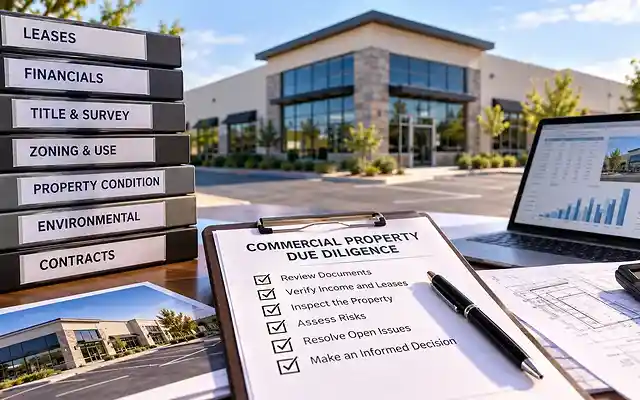
Commercial property due diligence is the process of testing an acquisition’s important claims against documents, independent findings, and the property’s actual condition before the buyer makes a final commitment under the purchase agreement.
A useful review does more than collect a rent roll, inspect the building, and obtain a title report. It establishes what was claimed, what evidence supports it, who checked it, what remains uncertain, and what the buyer decided to do about it.
This guide gives investors and acquisition teams a practical workplan for buying an existing income-producing commercial property in the United States.
It explains how to organize requests, reconcile leases and collections, coordinate specialists, control deadlines, and document a final decision.
The exact scope depends on the property, transaction structure, negotiated contract, location, financing, and professional advice.
If you need an overview of property types, investment risks, and commercial operating models first, see Commercial Real Estate Investing. Here, the objective is to execute and document the investigation of a specific acquisition.
Start With the Decision You Need to Make
Before asking the seller for another folder of documents, write down the assumptions that could change your purchase decision:
- Income: Are the leases current, enforceable as understood by counsel, and consistent with the advertised rent roll?
- Collections: Is billed income turning into cash, and are arrears or concessions concealed by summary figures?
- Expenses and capital needs: Which obligations will remain with the owner, and what work may be required after closing?
- Legal use and access: Can the buyer own and operate the property as intended, subject to applicable law and actual documents?
- Physical and environmental condition: Could defects, environmental concerns, or required work materially alter the price or feasibility?
- Execution: Can outstanding questions be answered before the relevant contractual and financing deadlines?
The answer to each question should lead to a decision: accept the verified assumption, revise it, seek specialist review, request a contractual remedy or extension where available, or decline the transaction if permitted. A long checklist without those decisions is only a record of activity.
Define what is being purchased
Confirm whether the deal is an asset purchase, an acquisition of an entity that owns the property, or a more complex structure.
That distinction can affect the records requested, liabilities considered, third-party consents, and legal review.
Have transaction counsel determine the applicable implications rather than assuming an entity acquisition is equivalent to a deed transfer.
Record the property type, address and parcel identifiers, current use, occupancy, major tenants, proposed business plan, purchase agreement parties, lender involvement, and any known access restrictions. Then identify which professionals are needed.
An office building with long-term commercial tenants may call for different lease, improvement-allowance, and rollover inquiries than a warehouse with heavy industrial use or an apartment property with many short-term leases.
Step 1: Create a Document Request and Evidence Register
Ask the seller or authorized representative for a dated, property-specific package. Depending on the transaction, the first requests may include:
- Executed leases, amendments, renewal and termination notices, guaranties, concession schedules, deposit records, and current tenant contact information or permitted access arrangements.
- A dated rent roll, tenant receivables aging, collection or cash ledgers, trailing 12-month operating statement (T-12), year-to-date results, and available prior-year statements.
- Property-tax bills and assessment notices, insurance policies and claims information, utility histories, service and management contracts, repair histories, capital-project records, and budgets.
- Existing title material, surveys, easements, zoning or use documentation, permits and certificates where relevant, and notices of violations or disputes known to the seller.
- Available property-condition reports, environmental assessments, engineering records, plans, warranties, and inspection access procedures.
Do not assume the seller possesses every record or is obligated to provide every item. The purchase agreement, negotiations, confidentiality rules, and applicable law determine what can be demanded or obtained. Missing records should remain visible as unresolved requests, not silently disappear from the analysis.
Use a register like this, adapting the fields to your deal:
| ID and claim to verify | Evidence requested | Supplied by; accountable verifier | Buyer-set cutoff tied to agreement | Status, exception and decision impact |
|---|---|---|---|---|
| L-01: occupied-space rent and lease rights | Signed leases, amendments, dated rent roll | Seller or manager; acquisition analyst and counsel | Before counsel-confirmed objection or decision deadline, allowing review time | Received; reconcile space and concessions; escalate missing amendments |
| F-02: historical income and collection reliability | T-12, general ledger, receivables aging and receipts | Seller or manager; financial reviewer | In time to reconcile before the applicable decision cutoff | Partial; ledger missing; hold claimed collection figure as unverified |
| P-03: cost and timing of major repairs | Roof and building-systems reports, site access | Seller and qualified inspector or engineer; buyer coordinator | Inspection report and follow-up before applicable review cutoff | Inspection booked; cost assumption pending |
| E-04: environmental conditions and transaction objectives | Existing environmental records and appropriately scoped independent assessment | Seller and environmental professional; counsel | Coordinate with report lead time and closing or contract dates as advised | Environmental review pending; assess findings before proceeding |
For every request, also maintain the date sent, document version and date, file location, person accountable, whether independent corroboration is available, an exception reference, and final disposition.
Received means the file arrived.
Verified means a designated reviewer checked the relevant claim, reconciled contradictory evidence where possible, and recorded remaining limitations.
For every row, retain the date requested, evidence version, reviewer sign-off, issue ID, and whether the finding changed the purchase assumption or transaction decision.
Establish an evidence hierarchy
Use the source most appropriate to the claim. For example, a seller’s marketing memorandum may describe rental income, but the signed lease and amendments establish the documented contractual terms, subject to legal interpretation.
Tenant ledgers and supportable collection records help establish what has been billed and received. Inspection findings speak to observed condition, not to a warranty that hidden defects are absent. Title documents and public records require interpretation by qualified counsel and title professionals.
Document both the original representation and its source. Keep dated copies of superseded rent rolls and statements rather than overwriting them; changes may explain why apparent discrepancies arise.
Step 2: Reconcile the Rent Roll With Actual Leases
A rent roll is a summary, not the underlying contract. Using a consistent as-of date, examine every material commercial lease and establish a documented, risk-sensitive review scope for larger multifamily portfolios, expanding the review if anomalies emerge or lender requirements call for it. For the leases and units selected for review, check:
- Tenant identity, occupied space, square footage or unit, and whether the space is actually occupied.
- Executed lease, amendments, commencement and expiration dates, renewal options, and termination rights.
- Current base rent, scheduled increases, free-rent periods, concessions, and amounts due under the agreement.
- Expense reimbursements, common-area maintenance terms, utility obligations, and reconciliation provisions where applicable.
- Security deposits, guaranties, disputed balances, arrears, and rights requiring counsel’s interpretation.
- Tenant improvements, leasing commissions, and other future landlord commitments.
Mark each row matched, requires clarification, or unverified. Do not convert a salesperson’s statement about a renewal into a signed renewal. If a lease is missing, request it and record the resulting uncertainty instead of assuming the rent roll is correct.
Tenant estoppel certificates may be useful when available or required by a contract, lender, or counsel. They can help corroborate specified lease facts, but their content, enforceability, and availability vary. They do not replace review of the executed lease or resolve every dispute automatically.
The Fannie Mae Multifamily Guide’s lease-audit framework illustrates why comparing a rent roll with signed leases and supporting tenant records is important.
Its particular audit thresholds and requirements apply to the transactions governed by that program, not automatically to every commercial buyer.
Distinguish occupancy from economic performance
A fully leased property can have late payments, concessions, rent-free periods, or tenants with termination rights.
Conversely, a short-term discrepancy between two reports may reflect different reporting dates or accounting treatment.
Keep physical occupancy, contractual billing, recorded revenue, and cash collections as separate fields until reconciled.
Step 3: Test Collections and the Seller’s T-12
A T-12 summarizes 12 months of operating activity, but it does not independently prove that every invoiced amount was collected.
Ask for supporting information appropriate to the asset and access granted, such as tenant ledgers, accounts-receivable aging, cash receipts journals, deposit records, and applicable general-ledger detail.
Work systematically:
- Confirm the T-12 start and end dates and whether entries are reported on a cash or accrual basis.
- Compare the rent roll’s dated schedule with lease obligations for that same period, allowing for increases, turnover, abatements, and new leases.
- Reconcile billed rent to tenant ledgers, credits, write-offs, and cash received where records are available.
- Trace material other-income and expense-reimbursement lines to lease terms and actual supporting records.
- Investigate material month-to-month movements instead of averaging them away.
- Log discrepancies that remain unresolved and ask the seller or manager for a documented explanation.
A difference between current annualized rent and the historical T-12 is not necessarily evidence of misconduct. They refer to different periods and may use different accounting conventions. The question is whether the bridge between them can be explained and supported.
Fannie Mae’s collections-validation guidance describes reviewing cash ledgers, receipts journals, bank deposits or comparable records and documenting findings. That is lender-program guidance and a useful reference for verification methods, not a universal requirement to obtain a particular number of bank statements.
Worked Example: When the Rent Roll Does Not Tell the Whole Story
Assume a hypothetical three-tenant retail building. The current rent roll and signed leases show the following monthly base rents, before reimbursements or other income:
| Tenant | Rent-roll base rent | Current signed-lease base rent | September cash received |
|---|---|---|---|
| A | $6,000 | $6,000 | $6,000 |
| B | $4,000 | $4,000 | $4,000 |
| C | $3,000 | $3,000 | $0 |
| Total | $13,000 | $13,000 | $10,000 |
First finding: a collection gap. The current monthly contractual base rent shown is $13,000, but only $10,000 appears in the September cash receipts supplied.
The $3,000 difference relates to Tenant C and requires reconciliation with the ledger, deposit records, timing, and any credit or dispute. It is not proof that the tenant will miss every future payment, nor proof that the amount is permanently uncollectible.
Second finding: a future concession. An amendment to Tenant B’s lease provides one full month of free base rent in the next 12 months, subject to its stated conditions. A simplified annualized schedule of $13,000 × 12 gives $156,000 in base rent before that concession.
If all other monthly base rents remain unchanged and the concession applies as assumed, the comparable 12-month contractual base-rent schedule is $152,000 ($156,000 minus $4,000).
This is a contractual schedule, not a cash-collection forecast. Tenant C’s unresolved payment is tracked separately, and reimbursement income and other charges are excluded from these figures.
Third finding: the historical period may differ. Suppose the seller’s T-12 shows $155,000 in reported base-rent income. That figure cannot be judged against either forward schedule without matching dates, actual tenant changes, concessions, and accounting treatment. The reviewer should create a month-by-month bridge using the leases, ledger, and statement detail.
A useful exception record would therefore say: Tenant C September cash receipts do not reconcile with billed base rent; $3,000 difference; collection status and reason unverified; request aging and deposit support before the decision cutoff.
A second record would flag the $4,000 prospective concession for the acquisition model. Whether these findings require repricing, additional reserves, more information, or no adjustment depends on what further evidence establishes.
This illustration is invented solely to explain the verification process. It is not an actual property, a market benchmark, or an appraisal.
Step 4: Verify Expenses, Contracts, and Near-Term Capital Work
Use the expense documents to identify which costs are real, recurring, or likely to change under new ownership.
Depending on the leases and asset, review property taxes, insurance, owner-paid utilities, payroll, maintenance, security, management fees, landscaping, cleaning, and contracted services. Compare billed amounts with invoices, contracts, and payment records where access permits.
For commercial leases, do not infer responsibility from the words ‘gross’ or ‘triple net’ alone. Read the actual lease: the owner may still have structural, roof, common-area, capital-replacement, administrative, or reconciliation obligations.
Check whether pass-through income is consistent with what the leases allow and what the tenants have actually paid.
Capital expenditures require a separate view. Ask for recent work orders, vendor reports, roof and mechanical-system histories, warranties, deferred-maintenance lists, and credible repair or replacement estimates.
A recently repaired system is not necessarily a newly replaced system. A seller’s forecast of next year’s repairs should be weighed against independent inspection findings.
Mark unusual or nonrecurring T-12 items for separate analysis, but do not simply remove them to make the property look more profitable.
A cost may be unusual in one year and still signal a recurring asset problem. Likewise, verify whether property taxes could change after transfer in the relevant jurisdiction rather than assuming the historical bill will continue unchanged.
For full investment calculations and financing-sensitive underwriting, use Real Estate Deal Analysis. This workplan establishes whether the inputs deserve reliance; it does not replace the financial model.
Step 5: Assign Legal, Title, Survey, and Property-Use Reviews
A property can have reliable collections and still fail the buyer’s intended use because of access, title, lease, or regulatory complications. Give these records an accountable reviewer rather than treating them as paperwork to file at closing.
Title, survey, easements, and physical access
Ask counsel and the title professional to review the current title commitment or equivalent available title materials, their exceptions, recorded easements, restrictions, liens, and any survey information appropriate to the transaction.
Check whether the survey, legal description, physical improvements, access, parking, and encroachments reveal issues requiring additional investigation.
An insured title policy does not automatically cover every physical or legal concern. Coverage and exclusions depend on the actual policy, endorsements, exceptions, and local requirements. Only qualified professionals can determine the effect of a particular exception or whether an objection must be raised under the contract.
Zoning, permitted uses, and existing agreements
Confirm the buyer’s intended operation against applicable local requirements, certificates or permits where relevant, and any existing use restrictions. Request records of known violations, pending proceedings, tax assessments, and material property disputes when applicable.
Have counsel review leases, guaranties, vendor agreements, loan-related instruments and any transfer, change-of-control, assignment, termination, or consent provisions relevant to the acquisition. An asset purchase and an entity purchase may expose different issues.
Record the specific determination needed. ‘Zoning checked’ is not a useful final entry. ‘Local counsel to confirm whether the intended industrial storage use is permitted for the identified parcel, with written result due before the contract decision date’ can be acted upon.
Step 6: Order Physical and Environmental Assessments Early
Physical inspections and environmental investigations often depend on site access, vendor availability, and time to obtain follow-up reports. Identify them early enough to preserve the relevant contractual decision options.
Physical condition
A qualified inspector or engineer may need to evaluate, as relevant, the roof and envelope, structure, electrical and mechanical systems, plumbing, elevators, fire and life-safety systems, drainage, parking, loading facilities, and potential accessibility concerns.
The scope must fit the building, its history, the intended use, and the specialist’s qualifications.
Ask the professional to distinguish immediate safety or functional concerns, deferred maintenance, approximate timing of major replacements, and items needing invasive or specialist follow-up. Record the report’s access limitations and excluded areas.
A property condition assessment is not a blanket guarantee against concealed defects.
The Fannie Mae Multifamily Guide’s property-condition framework provides an example of formal inspection and repair assessment in that lender program, not a nationwide inspection rule for every property transfer.
Environmental risk
Environmental investigation should consider current and former uses of the site and nearby properties, as well as the buyer’s liability objectives and lender requirements. The U.S. Environmental Protection Agency explains that All Appropriate Inquiries (AAI) is a defined process for evaluating environmental conditions and potential contamination liability.
EPA recognizes ASTM E1527-21 for a qualifying Phase I environmental site assessment under its AAI framework. See EPA’s All Appropriate Inquiries guidance.
For a buyer seeking certain federal landowner liability protections, the timing and content of AAI can matter: EPA describes a one-year lookback before acquisition, with certain components required or updated within 180 days.
Eligibility also depends on other requirements, including applicable continuing obligations. Have environmental counsel and a qualified environmental professional assess the actual transaction.
A Phase I report evaluates specified environmental risk indicators. It does not certify that a property is contamination-free or address every possible environmental, safety, or building-condition concern.
If potential releases or significant data gaps emerge, the specialist may recommend further work, potentially including sampling or a Phase II investigation. Do not order testing blindly or assume a clean executive summary resolves every issue.
Step 7: Tailor the Workplan to the Asset
The register and decision method can remain consistent across assets, but the substantive requests should change.
- Office: Reconcile scheduled lease expirations, expansion or termination rights, tenant improvement allowances, commissions, major HVAC responsibilities, and tenant concentration.
- Retail: Check percentage-rent or expense-reimbursement provisions where present, co-tenancy or anchor-related rights, signage and parking arrangements, storefront condition, and tenant-specific sales or use issues when relevant and obtainable.
- Industrial: Investigate environmental history, permitted industrial uses, loading and access, electrical capacity, ceiling and floor constraints, and tenant-specific alterations that may reduce re-leasing flexibility.
- Larger multifamily: Reconcile unit-level leases, renewals, concessions, vacancy, receivables, utility allocation, operating labor, and the inspection sample or scope appropriate to the property and lender.
A 30-year-old industrial property with past manufacturing uses and a newly renovated multifamily building should not receive identical environmental, systems, lease, or operational investigations.
Specialist hospitality, healthcare, and development assets may require substantially different workplans beyond the scope of this guide.
Step 8: Control the Calendar and Reviewer Responsibilities
A complete due-diligence package delivered after the buyer’s effective objection or termination deadline may be of limited practical value.
Treat the executed purchase agreement, amendments, and counsel’s deadline interpretation as the authoritative timeline.
There is no single national due-diligence period that applies to every U.S. commercial property sale.
Create one live calendar with these fields:
- Contract event or deliverable and the exact contractual provision being tracked.
- Deadline, time zone, triggering event, and any notice-delivery method specified by the agreement.
- Responsible buyer-side owner, seller contact, outside reviewer, and dependent tasks.
- Latest acceptable receipt date, review buffer, and escalation date set by the team.
- Status, last communication, outstanding information, and confirmation of proper notice where counsel advises it is necessary.
Example of a contract-linked review tracker
This illustration uses milestones rather than a universal number of diligence days. Counsel must confirm the actual dates and notice procedures from the executed agreement.
| Deliverable | Assigned reviewer and follow-up owner | Internal target and escalation |
|---|---|---|
| Signed lease and concession verification | Financial analyst; acquisition lead follows up with seller | Complete before counsel-confirmed objection cutoff; escalate missing amendments in time for review |
| Environmental findings and specialist recommendations | Environmental professional; counsel coordinates legal implications | Order early enough for potential follow-up; escalate material findings before the applicable decision cutoff |
| Title and access exceptions | Title professional and counsel; acquisition lead tracks closure | Obtain written issue disposition before any notice or objection deadline |
| Final investment decision file | Acquisition lead and designated approval authority | Circulate validated assumptions and unresolved items before the contract decision deadline |
The internal review buffer is a management safeguard, not an invented contractual grace period. Confirm who has authority to issue notices and whether the agreement permits an extension.
A buyer should not assume that a late seller delivery automatically extends a contractual deadline; have counsel interpret the specific terms and any applicable law.
Start long-lead assessments and lender coordination as early as the transaction allows. If the lender requires environmental or inspection documentation, confirm the scope directly with the lender and advisers. For lending structures and borrower obligations, see Investment Property Financing.
Step 9: Use an Exception Log Instead of Hiding Unanswered Questions
An effective exception log links claims, evidence and decisions. Each unresolved issue should state:
- Issue ID and date: When was it found, and by whom?
- Seller representation: What specific claim is being tested?
- Conflicting or missing evidence: Which dated document or inspection result raises the question?
- Potential consequence: Does it affect income, expenses, required work, legal use, financing, or closing ability?
- Responsible reviewer: Who can verify it, and whose professional opinion is needed?
- Next action and cutoff: What information is requested, and when must it arrive?
- Disposition: Verified and closed; mitigated; reflected in a revised assumption; unresolved and elevated; or incorporated into a contract decision.
For the hypothetical three-tenant retail property above, an exception entry could read: F-02 / Open: Tenant C’s September base rent was $3,000, but provided September cash receipts show $0.
The acquisition analyst requests the tenant ledger, receipts and timing explanation from the property manager. The financial reviewer keeps the $3,000 difference unresolved until the evidence reconciles or the acquisition assumptions are revised.
The buyer’s coordinator escalates the issue before the counsel-confirmed decision cutoff. Separately, L-01 records Tenant B’s documented prospective $4,000 concession as an adjustment to the forward contractual rent schedule, not proof of a $4,000 cash loss in the historical T-12.
A simple issue might involve a lease expense-reimbursement discrepancy. A more serious one could be an unresolved title access exception or potentially material environmental finding.
Neither should be marked closed merely because the seller responded. The response must actually resolve the question or the buyer must knowingly accept and document the residual uncertainty.
When the evidence supports a potential financial adjustment, ask the appropriate reviewer to model it. If the problem concerns contractual remedies, notice requirements, or regulatory compliance, refer it to counsel or the qualified specialist.
The acquisitions team integrates the conclusions but should not impersonate those professions.
Step 10: Produce a Decision Record Before the Cutoff
The final deliverable is a short, dated investment decision record, not another pile of attachments. It should state:
- Property and transaction: Identifiers, buyer, deal structure, proposed price, current contract version, decision deadline, and reviewer names.
- Verified assumptions: Material lease terms, collected income, operating costs, capital condition, title and use findings, and supporting evidence versions.
- Adjusted assumptions: Every material change from the original investment case, with the reason and person approving the revision.
- Unresolved issues: Open exception IDs, exposure or uncertainty that cannot be quantified, and which professional has advised on them.
- Available contractual paths: Proceed, negotiate revised terms, request additional time where the agreement allows, or decline/exercise a contractual right if available and properly advised.
- Decision and authority: Who decided, when, on what information, and which notices or approvals remain necessary.
Example: A documented acquisition decision
For the same fictional three-tenant retail property, the acquisition lead prepares a dated decision record based on the information available as of the internal review date.
The executed agreement, property identifiers, actual price, approval authority and contractual deadline must be inserted from the real transaction rather than assumed here.
- Verified information: The three signed leases support $13,000 in current monthly base rent. Tenant B’s amendment provides one $4,000 prospective free-rent month, producing a hypothetical $152,000 12-month contractual base-rent schedule before collections, reimbursements or other adjustments.
- Unresolved evidence: The September receipts presented show $10,000 rather than $13,000. Tenant C’s $3,000 difference remains open as issue F-02. The seller’s historical $155,000 T-12 base-rent figure has not yet been bridged to its actual accounting period and support.
- Assigned actions: The financial reviewer reconciles F-02 and the historical income bridge. Counsel confirms contractual rights, notice procedures and the actual decision deadline. Relevant property-condition and environmental reports must be separately evaluated before approving their assumptions.
- Recorded decision: Do not authorize an unconditional proceed decision on the current income assumptions. Obtain and evaluate the missing support before the applicable cutoff. If that is not feasible, have authorized decision makers and counsel assess available extension, renegotiation or termination options under the signed agreement; none is guaranteed.
- Audit trail: Retain the dated rent roll, signed lease and amendment versions, September collection evidence, unresolved issue records, reviewer notes, contractual notices where applicable, and the final authorized decision.
This is a hypothetical documentation example, not a recommendation to accept or reject a real property or a statement that a buyer can suspend contractual deadlines.
A proceed decision should not claim the property is free of risk. It means the buyer has documented the evidence, known uncertainties, and acceptance of the transaction on the terms under consideration.
A renegotiation request is not itself a binding price adjustment. An extension request is not an approved extension unless validly agreed under applicable documents.
A decision to terminate requires analysis of the actual contractual rights and procedures.
Save the decision record with an indexed evidence file: original and updated seller documents, signed agreements, tenant reconciliation, ledger bridges, specialist reports and limitations, issue history, written advice where retainable, notices, amendments, and final approvals.
Use appropriate security and access controls for confidential tenant, financial, and legal information. Your counsel and organization should guide retention and privilege questions.
Commercial Property Due Diligence Checklist: Final Decision Controls
Before the applicable decision deadline, confirm that the team can answer these questions:
- Do we know exactly what property interests and obligations are being acquired?
- Have material rent-roll entries been checked against signed leases and amendments?
- Are collection gaps, concessions, arrears and unusual T-12 variances explained or explicitly open?
- Have important owner expenses, service obligations and capital needs been independently reviewed where feasible?
- Have counsel and relevant specialists reviewed title, access, intended use and transaction-specific consents?
- Are physical and environmental report findings and limitations understood?
- Is every material exception assigned, dated, and either resolved or deliberately accepted?
- Has counsel confirmed the actual notice, objection and decision deadlines?
- Have changes to the original investment case been recorded and, if needed, separately underwritten?
- Is the authorized investment decision documented with supporting evidence and any necessary follow-up actions?
If you cannot answer a material question, mark it unresolved. That is more useful than a checked box with no supporting record.
Common Questions About Commercial Acquisition Due Diligence
How long does commercial property due diligence take?
It depends on the negotiated agreement, asset complexity, seller responsiveness, site access, and the time required for legal, physical, environmental and financing reviews. A nationally applicable deadline cannot be inferred from a generic checklist. Have counsel identify the dates and rights in the actual purchase agreement, and schedule specialists accordingly.
How much does commercial real estate due diligence cost?
There is no reliable universal fee. Cost depends on property size and type, location, access, environmental history, title and survey needs, legal complexity, inspection scope, specialist rates, and whether follow-up testing or engineering is needed. Seek written, scope-specific proposals before committing funds, and keep contingencies for justified follow-up work. The cheapest investigation may omit a risk that matters; the most expensive is not automatically the most appropriate.
What if the seller cannot provide a lease or complete operating statement?
Record the specific missing item and why it matters, request acceptable alternative evidence, and ask counsel and financial reviewers to evaluate the gap. Do not silently treat an unverified figure as true. If the information remains unavailable at the relevant decision point, document the uncertainty and assess the contractual options.
Is a due-diligence checklist enough to buy commercial property?
No. A checklist helps identify tasks, but it does not establish whether documents are current or reliable, whether conflicting information has been reconciled, or whether the team acted before the relevant deadlines. A buyer needs a request register, assigned reviewers, an exception log and a decision record that links evidence to the acquisition choice.
The Bottom Line
Commercial property due diligence is complete for decision-making purposes only when the buyer can explain the property’s important claims, identify the documents and people relied on, disclose material unanswered questions, and take the appropriate contractual decision on time. Verification is not the elimination of all risk. It is a disciplined way to make assumptions testable and uncertainty visible.
Keep the verified document register, unresolved exception log, revised assumptions, and authorized decision record together. The next step is to carry supported findings into the property’s separate underwriting and investment-approval process, rather than treating a completed checklist as proof that every risk has been removed.