Rental Property Analysis: How to Analyze a Rental Property Step by Step

Rental property analysis is the process of testing whether a potential rental can produce acceptable results under realistic income, expense, financing, and risk assumptions.
The goal is not to find one attractive metric. It is to build a chain of assumptions that makes sense together. A property can have a strong cap rate and weak cash flow after financing. It can show positive cash flow but still require more cash, repairs, or risk than your plan allows. It can also look profitable on a seller’s pro forma and fail once rent, vacancy, insurance, taxes, maintenance, or financing are verified.
A useful analysis separates property economics from investor economics. Property economics ask what the real estate itself produces before financing. Investor economics ask what remains after the way you choose to finance and capitalize the purchase.
This guide explains how to analyze a rental property step by step, from verifying market rent and building an operating budget to calculating net operating income, cap rate, cash flow, cash-on-cash return, debt-service coverage, and downside scenarios.
This guide focuses on long-term residential rental property. Short-term rentals and larger multifamily or commercial properties can require materially different revenue, expense, financing, and regulatory assumptions.
For the broader underwriting framework that applies across multiple real estate strategies, see Real Estate Deal Analysis.
Important: The examples in this guide are educational and hypothetical. Actual rents, expenses, financing terms, taxes, insurance costs, lender calculations, and acceptable returns vary by property, market, borrower, strategy, and jurisdiction. Verify material assumptions before making an investment decision.
What Rental Property Analysis Is
Rental property analysis converts a property listing and a set of expectations into an investment model you can test.
At a minimum, the process should answer five questions:
- What income can the property reasonably produce?
- What will it cost to operate before financing?
- What does the property produce before debt?
- How does the financing change the investor’s cash flow and return?
- What happens if important assumptions are worse than expected?
That process is different from simply asking whether rent exceeds the mortgage payment.
Screening versus full underwriting
A screen is a fast first pass. It may use estimated rent, estimated expenses, and rough financing assumptions to decide whether a property deserves more attention.
Full underwriting replaces rough estimates with verified or better-supported information. That may include current leases, comparable rents, property tax records, insurance quotes, inspection findings, utility responsibilities, management pricing, repair estimates, and actual financing terms.
Screening helps you reject obvious mismatches quickly. Underwriting helps you decide whether the opportunity still works when the assumptions become more precise.
A disciplined process usually moves from rough estimates to verified inputs as the transaction progresses.
Step 1: Start With the Investment Criteria
Before analyzing a property, define what the property needs to accomplish.
Useful criteria may include:
- investment strategy;
- expected hold period;
- property type;
- available cash;
- acceptable renovation scope;
- preferred level of management involvement;
- target measures of return;
- liquidity needs;
- tolerance for vacancy or repair risk; and
- conditions that would cause you to reject the deal.
This matters because the same property can produce different conclusions for different investors.
For example, an investor prioritizing current income may reject a property with thin cash flow even if it has long-term appreciation potential. An investor pursuing a value-add strategy may accept lower initial income if renovation creates a credible path to higher rent or value. Neither conclusion is automatically correct without the strategy behind it.
If you are still deciding which rental strategy fits your goals, review Rental Property Investing before turning the analysis into a pass-or-fail decision.
Step 2: Verify the Market Rent
Rent is usually the largest income assumption in a long-term rental analysis, so an inflated rent estimate can distort every metric that follows.
Do not rely only on:
- the seller’s projected rent;
- the highest active listing you can find;
- a single automated estimate;
- the current rent if the lease is materially above or below market; or
- a rent figure that assumes improvements you have not yet budgeted for.
Compare like with like
Use rental evidence that is reasonably comparable in:
- neighborhood or submarket;
- property type;
- bedroom and bathroom count;
- square footage;
- condition;
- parking;
- amenities;
- utility responsibilities;
- lease structure;
- concessions or move-in incentives that affect effective rent;
- unit mix for multi-unit properties where relevant; and
- recency of the comparable evidence.
A renovated three-bedroom home with a garage may not be a useful rent comparable for an older three-bedroom home without parking simply because both are in the same ZIP code.
Look for a range rather than one perfect comparable. The purpose is to understand what a typical tenant would plausibly pay for the subject property in its expected condition.
If market selection or neighborhood fundamentals are still uncertain, use the framework in Real Estate Market Analysis before treating a rent assumption as reliable.
Separate in-place rent from market rent
For an occupied property, record both:
- in-place rent, which is what the current lease actually requires; and
- market rent, which is what current comparable evidence suggests.
Do not assume you can immediately raise an existing tenant to market rent. Lease terms, notice requirements, rent regulation, local law, tenant retention, property condition, and market conditions may affect what is possible and when.
Include other income only when it is supportable
Some rentals may produce additional income from parking, laundry, storage, pet fees, utility reimbursements, or other sources.
Include additional income only when there is a reasonable basis for expecting it. If the income depends on a future operational change, improvement, or fee structure, label it as an assumption instead of treating it as established revenue.
Step 3: Estimate Vacancy and Credit Loss
A rental analysis should not assume that every scheduled dollar of rent will be collected every month forever.
Vacancy and credit loss can reflect:
- time between tenants;
- uncollected rent;
- lease-up periods;
- seasonal demand;
- tenant turnover;
- renovation downtime; and
- market weakness.
There is no universal vacancy percentage that belongs in every rental-property model.
A better approach is to use evidence from the property and market. Consider historical occupancy where reliable records exist, comparable-property performance, current vacancy conditions, tenant turnover, lease expiration timing, and the property’s competitiveness.
For a hypothetical first-pass model, you may need to use an estimate. If so, label it clearly and stress-test it later.
Do not confuse lender qualifying rules with investor underwriting
Mortgage lenders may apply their own formulas when deciding how much rental income can be used to qualify a borrower.
For example, Fannie Mae’s September 2, 2026 guidance for certain investment-property purchase transactions uses a percentage of documented gross rent to determine qualifying rental income. That is a mortgage qualification method, not a universal investor rule for vacancy, operating expenses, or property profitability. Fannie Mae: Rental Income from the Subject Property.
Your investment analysis should model the property’s expected economics using assumptions appropriate to that property and market.
Step 4: Build the Operating-Expense Budget
Once income is estimated, build the cost side of the property before financing.
Potential operating expenses include:
- property taxes;
- property insurance;
- routine repairs and maintenance;
- property management;
- owner-paid utilities;
- HOA or condominium fees;
- landscaping;
- snow removal;
- pest control;
- licensing or inspection fees;
- administrative costs;
- recurring service contracts;
- recurring turnover or lease-up costs where relevant; and
- other property-specific operating costs.
Not every property will have every expense. The objective is to include the expenses that actually apply.
Model management even if you plan to self-manage
If you plan to manage the rental yourself, you may choose to show no cash management fee in your personal cash-flow model.
However, it can still be useful to test the property with a market-based management expense. That helps answer a separate question:
Would the investment still work if you later hired management?
This can matter if your time availability changes, the portfolio grows, or you eventually want the property to operate with less direct involvement.
Separate routine maintenance from large capital items
Routine maintenance and repairs are part of normal property operations.
Large, irregular items such as a roof replacement, major HVAC replacement, or substantial building-system work may be better modeled separately as capital expenditures or reserves, depending on the analytical convention you use.
The key is consistency. If a capital reserve is excluded from NOI, do not forget it when calculating the investor’s expected cash flow.
Tax accounting is not the same as investment underwriting
The IRS discusses categories such as maintenance, insurance, taxes, mortgage interest, management fees, repairs, utilities, and depreciation when explaining federal rental-property tax treatment. IRS Publication 527, Residential Rental Property.
That does not mean an investor should copy Schedule E categories directly into an NOI calculation.
For investment analysis:
- mortgage interest is part of financing, not property-level operating expense in the NOI calculation used in this guide;
- mortgage principal is debt service, not an operating expense;
- depreciation is a tax/accounting item, not a cash operating expense; and
- capital expenditures may be treated separately from recurring operating expenses.
For a broader tax discussion, see Real Estate Investing Taxes.
Step 5: Calculate Net Operating Income
Net operating income, or NOI, measures property-level income before financing and investor income taxes.
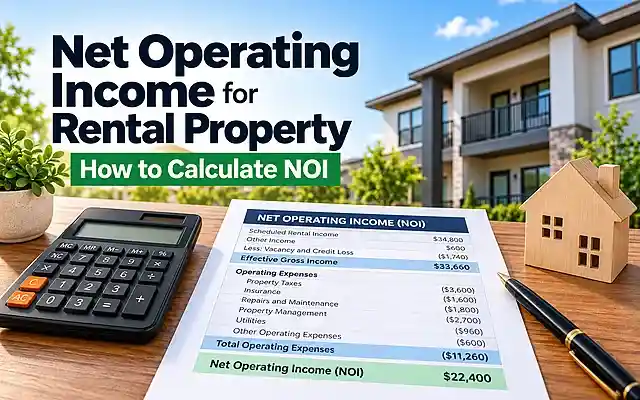
A simplified formula is: NOI = Effective Gross Income – Operating Expenses
For a basic long-term rental model: Effective Gross Income = Scheduled Rental Income + Other Operating Income – Vacancy and Credit Loss
Then subtract the operating expenses that belong in your chosen NOI convention.
What NOI should not include in this analysis
To keep property performance separate from financing, this guide does not subtract:
- mortgage principal;
- mortgage interest;
- investor income taxes; or
- depreciation
when calculating NOI. If you model a capital-expenditure reserve below NOI, state that explicitly so the later cash-flow calculation remains understandable.
NOI conventions are not identical across every lender or analytical framework. Some institutional underwriting approaches include a replacement reserve within NOI. This guide keeps the separate capital reserve below NOI in the worked example so the convention is visible. Whichever convention you use, apply it consistently when calculating cap rate, cash flow, and DSCR.
Why NOI matters
NOI is useful because it lets you examine the property before your personal financing structure is added.
Two investors could buy the same property using different loan terms. The property’s NOI can be the same for both investors even though their cash flow and cash-on-cash returns are different.
That makes NOI a bridge between property-level performance and financing-dependent returns.
Step 6: Calculate the Cap Rate
The capitalization rate compares NOI with the property’s price or value.
A common formula is: Cap Rate = Annual NOI / Purchase Price
If a property produces $20,000 of annual NOI and costs $300,000: $20,000 / $300,000 = 6.67%
Cap rate is financing-neutral because debt service is not included in NOI.
For a deeper walkthrough of the formula, NOI assumptions, price-versus-value differences, and how to interpret the result, see our Rental Property Cap Rate guide.
What cap rate can tell you
Cap rate can help you:
- compare income production relative to price;
- compare similar properties in the same market;
- see how changes in price or NOI affect unleveraged yield; and
- separate property economics from your financing structure.
What cap rate cannot tell you
Cap rate does not directly account for:
- loan terms;
- down payment;
- closing costs;
- investor-specific cash invested;
- future capital expenditures;
- appreciation;
- tax consequences; or
- the timing of future cash flows.
There is also no universal “good cap rate.” A cap rate that appears attractive in one market or property type may reflect materially different risk than the same cap rate somewhere else. Use cap rate as one metric, not the verdict.
Step 7: Add the Financing
After understanding the property before debt, add the proposed financing.
Useful loan inputs include:
- purchase price;
- down payment;
- loan amount;
- interest rate;
- amortization period;
- loan term;
- points and lender fees where relevant;
- prepayment provisions where relevant; and
- required reserves or other financing-related cash needs.
For a standard amortizing loan, calculate the monthly principal-and-interest payment using the actual quoted loan terms rather than a generic online assumption whenever those terms are available.
For a broader comparison of loan structures and borrowing tradeoffs, see Investment Property Financing.
Keep property taxes and insurance from being double counted
If property taxes and property insurance are already included in operating expenses above NOI, do not subtract them a second time when you add debt service.
This is one reason investors should understand what a mortgage payment figure includes. A lender may quote or qualify using a payment that includes principal, interest, taxes, insurance, and association dues, while an investment model may treat taxes, insurance, and HOA fees as property operating expenses and principal plus interest as debt service. Use one consistent structure.
Step 8: Calculate Cash Flow
Cash flow estimates how much cash remains after property operations and financing.
A simplified annual formula is: Pre-Tax Cash Flow = NOI – Annual Debt Service. If you model certain items separately from NOI, subtract them here as well.
For example: Investor Cash Flow After Separate Capital Reserve = NOI – Debt Service – Capital Reserve. This makes the treatment of reserves visible instead of burying them inside another category.
For a focused walkthrough of this calculation, see our Rental Property Cash Flow guide for the step-by-step path from rent and vacancy through operating expenses, debt service, reserves, and monthly cash flow.
Monthly versus annual cash flow
Annual cash flow is useful for return calculations. Monthly cash flow can be useful for budgeting, but dividing annual cash flow by 12 does not mean every month will produce that amount. Rental income and repairs can be uneven.
A roof repair, tenant turnover, insurance renewal, or tax payment can make individual months look very different from an annual average.
Step 9: Calculate Cash-on-Cash Return
Cash-on-cash return compares annual pre-tax cash flow with the amount of cash you invested.
A common formula is: Cash-on-Cash Return = Annual Pre-Tax Cash Flow / Total Cash Invested
“Total cash invested” should be defined consistently. Depending on the analysis, it may include:
- down payment;
- closing costs;
- lender fees or points paid in cash;
- immediate repairs;
- initial renovation costs; and
- other cash required to place the property into its intended operating condition.
If you exclude a material cash requirement from the denominator, the resulting return can look better than the investor’s actual capital commitment.
What cash-on-cash return misses
Cash-on-cash return can be useful, but it does not measure everything.
It may not fully capture:
- principal paydown;
- appreciation;
- future sale proceeds;
- tax effects;
- major future capital expenditures;
- changes in rent or expenses; or
- differences in risk.
A higher cash-on-cash return is not automatically a better investment if it comes from more leverage, weaker reserves, greater operational risk, or assumptions that are less reliable.
Step 10: Use DSCR Carefully
Debt-service coverage ratio, or DSCR, compares property-level income with debt service.
A common form is: DSCR = NOI / Annual Debt Service.
For example, if NOI is $22,000 and annual debt service is $18,000: $22,000 / $18,000 = 1.22
That means the modeled NOI is 1.22 times the modeled annual debt service.
The Office of the Comptroller of the Currency uses the same basic NOI-to-annual-debt-service relationship when discussing DSCR in commercial real estate lending.
It also emphasizes that an appropriate DSCR depends on factors such as cash-flow stability and loan structure. OCC: Commercial Real Estate Lending, Version 2.0.
That is useful conceptual context, but it should not be turned into a universal residential-rental threshold.
Different lenders and loan products may define income, expenses, debt service, or required coverage differently. If a lender is using DSCR to qualify your loan, use that lender’s actual calculation and requirements for the financing decision.
For investment analysis, DSCR is best treated as another view of the property’s ability to support debt rather than a stand-alone pass-or-fail rule.
Step 11: Run a Stress Test
A base-case analysis answers one question: What happens if the assumptions are approximately right?
A stress test asks another: What happens if several important assumptions are worse? Useful stress-test variables include:
- lower rent;
- higher vacancy;
- higher maintenance;
- higher insurance;
- higher property taxes;
- a major capital event;
- slower lease-up;
- higher management costs; and
- worse financing terms if the rate or loan structure is not yet locked.
The objective is not to predict the future perfectly. The objective is to understand sensitivity.
If a modest change in rent or expenses turns a comfortable result into a loss, the property has less room for error than a deal whose economics remain acceptable across several plausible scenarios.
Stress one variable at a time and then combine them
Testing one variable helps you see what the property is most sensitive to. A combined downside scenario shows what happens when multiple things go wrong at the same time.
Both views can be useful. For example, you might test:
- rent 5% below the base case;
- vacancy higher than the base case;
- maintenance materially higher;
- insurance above the quote used in the first screen; and
- financing at a higher rate if terms are not locked.
Those percentages should be chosen for the specific property and market. They are scenario inputs, not universal recommendations.
Worked Example: Analyze One Rental Property From Start to Finish
The following example is an entirely hypothetical long-term single-family rental. It is designed to show how the pieces of rental property analysis fit together, not to represent a current market, recommended financing structure, or target return.
Hypothetical property assumptions
| Input | Base-case assumption |
|---|---|
| Purchase price | $300,000 |
| Monthly market rent | $2,900 |
| Scheduled annual rent | $34,800 |
| Vacancy and credit-loss assumption | 5% |
| Down payment | 25% |
| Loan amount | $225,000 |
| Interest rate | 7.00% |
| Amortization | 30 years |
| Closing costs paid in cash | $6,000 |
| Immediate repairs paid in cash | $9,000 |
| Separate annual capital reserve | $2,000 |
The 5% vacancy assumption, 25% down payment, 7% rate, and every other value above are hypothetical inputs for this example only.
They are not Realty Crafts recommendations or statements about current lender requirements.
1. Calculate effective rental income
Scheduled annual rent: $2,900 x 12 = $34,800
Hypothetical vacancy and credit loss: $34,800 x 5% = $1,740
Effective gross income: $34,800 – $1,740 = $33,060
No additional operating income is assumed in this example.
2. Build the operating-expense budget
| Operating expense | Annual assumption |
|---|---|
| Property taxes | $4,200 |
| Insurance | $1,800 |
| Routine maintenance | $1,650 |
| Property management | $2,645 |
| Owner-paid utilities | $600 |
| Licensing / recurring administrative cost | $165 |
| Total operating expenses | $11,060 |
The property-management line is approximately 8% of effective gross income in this hypothetical example. It is an example input, not a universal management fee.
The $2,000 capital reserve shown earlier is intentionally not included in NOI. It will be modeled separately below so the convention is visible.
3. Calculate NOI
NOI = $33,060 – $11,060
NOI = $22,000
The slight rounding in the expense table is intentional for readability.
4. Calculate cap rate
Cap Rate = $22,000 / $300,000
Cap Rate = 7.33%
That is the property’s modeled unleveraged income yield under the assumptions above. It is not a conclusion that the property is a good investment.
5. Add the financing
With a hypothetical $225,000 loan at 7.00% interest amortized over 30 years, the monthly principal-and-interest payment is approximately $1,496.93
Annual principal-and-interest debt service is approximately $17,963
Taxes and insurance are not added again here because they were already included in the operating-expense budget.
6. Calculate cash flow
Cash flow before the separately modeled capital reserve: $22,000 NOI – $17,963 debt service = $4,037
Then subtract the annual capital reserve: $4,037 – $2,000 = $2,037
Modeled annual investor cash flow after the separate reserve: $2,037
Average monthly equivalent: $2,037 / 12 = about $170
That does not mean the investor receives exactly $170 every month. Actual rental cash flow is uneven.
7. Calculate total cash invested
Down payment: $75,000
Closing costs: $6,000
Immediate repairs: $9,000
Total cash invested: $75,000 + $6,000 + $9,000 = $90,000
This example does not assume a separate lender-required reserve deposit or restricted operating account at closing. If a real transaction requires additional cash to be funded, restricted, or committed, identify it separately and treat it consistently in the return analysis.
8. Calculate cash-on-cash return
Cash-on-Cash Return = $2,037 / $90,000
Cash-on-Cash Return = about 2.26%
This uses cash flow after the separately modeled capital reserve. If an investor used a different reserve convention, the result would differ. That is why the components of the formula should be visible.
9. Calculate DSCR
Using NOI and principal-and-interest debt service as defined in this example:
DSCR = $22,000 / $17,963
DSCR = about 1.22
Again, this is an investor-model calculation for the example. A lender may use a different definition or qualifying method.
10. Stress-test the example
Now assume a combined downside scenario:
- achievable rent is 5% below the base assumption;
- vacancy and credit loss rise to 8%;
- routine maintenance rises by 25%;
- insurance rises by 15%;
- management remains 8% of effective gross income;
- taxes, utilities, and licensing remain unchanged;
- the same loan terms remain in place.
Under those hypothetical stress assumptions:
- effective gross income falls to about $30,415;
- operating expenses rise to about $11,531;
- NOI falls to about $18,884;
- DSCR falls to about 1.05;
- cash flow before the separate capital reserve falls to about $921; and
- cash flow after the $2,000 reserve becomes approximately -$1,079.
That is the central value of the stress test.
The base case showed positive cash flow. The combined downside case showed that the property has limited room for several assumptions to deteriorate at once.
An investor could respond by investigating the assumptions further, negotiating a lower price, changing the financing, accepting the risk for a strategy-specific reason, or passing. The model does not make that decision automatically.
How to Decide
Rental property analysis should lead to a decision process, not merely a spreadsheet result.
Buy
A property may remain a candidate to buy when:
- major assumptions have been verified;
- the property meets the investor’s predefined criteria;
- financing is supportable;
- the downside is acceptable;
- material repairs and operating risks are understood; and
- the investor still has adequate liquidity after closing.
“Buy” here does not mean the property is objectively right for every investor. It means the opportunity still fits the criteria used in that specific analysis.
Negotiate
A property may be worth negotiating when the opportunity works only at different economics.
That could involve:
- a lower purchase price;
- seller credits where appropriate;
- repair concessions;
- different financing;
- a different closing structure; or
- another term that changes the risk-adjusted result.
The purpose of negotiation is not to rescue every weak deal. It is to see whether the economics can be brought within the investor’s criteria.
Investigate
Use “investigate” when the decision depends on material information that is not yet reliable.
Examples include:
- uncertain market rent;
- an insurance quote that has not been obtained;
- unclear utility responsibility;
- unknown repair scope;
- missing lease documents;
- questionable property-tax assumptions;
- zoning or rental-use questions; or
- financing terms that remain preliminary.
Unknowns should not automatically be entered as optimistic numbers.
Pass
Passing can be the correct result when:
- the property fails the required return or risk criteria;
- the downside scenario is unacceptable;
- material facts cannot be verified;
- needed repairs exceed the investor’s capacity;
- the financing makes the deal too fragile;
- the purchase would consume too much liquidity; or
- another identified risk falls outside the investor’s plan.
The purpose of analysis is not to prove that a property works. It is to determine whether it does.
If you are moving from analysis into the acquisition process, use How to Buy a Rental Property for the sequence from financing and offers through due diligence and closing.
Common Rental Property Analysis Mistakes
Using asking rent instead of verified market rent
A listing’s projected rent is an input to investigate, not a fact to copy into the model.
Treating rent minus mortgage payment as cash flow
This ignores vacancy and operating costs and mixes property economics with financing too early.
Assuming 100% occupancy
Even strong rentals can have turnover, downtime, or collection loss. Use a supportable assumption and stress-test it.
Ignoring management because you plan to self-manage
Self-management can reduce cash expenses, but it still requires time and operational capacity. Testing a management expense can show whether the property remains viable if your operating model changes.
Ignoring capital expenditures
A property can show attractive current cash flow while major building systems are approaching replacement. Model material capital needs somewhere in the analysis.
Copying seller expenses without verification
Seller-reported expenses may be incomplete, unusually low, based on a different operating model, or no longer applicable after the sale.
Mixing NOI with debt service
NOI is designed to show property performance before financing in the framework used here. Subtracting debt service inside NOI destroys that distinction and can make comparisons confusing.
Using one metric as the decision
Cap rate, cash flow, cash-on-cash return, and DSCR answer different questions. None should be treated as the universal verdict.
Using lender qualifying rent as your investment assumption
A lender’s method is designed to evaluate mortgage qualification under that lender or program’s rules.
Fannie Mae’s current guidance, for example, uses specified documentation and qualifying-income calculations for rental property. Those formulas should not be mistaken for a universal investor vacancy allowance or operating budget. Fannie Mae: General Rental Income Information.
Failing to rerun the analysis
The model should change when the facts change.
Re-underwrite after material developments such as:
- inspection findings;
- actual insurance pricing;
- confirmed financing;
- lease review;
- property-tax clarification;
- updated repair estimates; or
- a negotiated purchase price.
A deal that worked at the first screen may not work after due diligence, and a marginal deal can sometimes improve when uncertainty is resolved.
Rental Property Analysis Checklist
Use this checklist to make sure the analysis is complete enough for the stage of the transaction.
Investment criteria
- Define the investment strategy.
- Establish the expected hold period.
- Identify the return metrics you will use.
- Set capital and liquidity limits.
- Define material risks that would cause you to reject the property.
Income
- Verify market rent with relevant comparables.
- Separate market rent from in-place rent.
- Include other income only when supportable.
- Estimate vacancy and credit loss.
- Avoid treating lender qualifying formulas as investor assumptions.
Operating expenses
- Verify property taxes.
- Obtain or estimate insurance appropriately.
- Include routine repairs and maintenance.
- Account for management.
- Include owner-paid utilities.
- Include HOA or condominium costs where applicable.
- Include recurring licensing, landscaping, pest, or service costs where relevant.
- Decide how capital expenditures or reserves will be modeled.
Property-level metrics
- Calculate effective gross income.
- Calculate NOI.
- Calculate cap rate.
- Keep financing outside NOI.
Financing and investor returns
- Enter the actual or best-supported loan assumptions.
- Calculate debt service.
- Avoid double counting taxes and insurance.
- Calculate cash flow.
- Define total cash invested.
- Calculate cash-on-cash return.
- Calculate DSCR if useful to the financing or risk analysis.
Downside analysis
- Stress rent.
- Stress vacancy.
- Stress operating costs.
- Test material capital needs.
- Test worse financing if terms are not locked.
- Identify which assumption has the greatest effect on the result.
Decision
- Compare the base case with your criteria.
- Compare the stress case with your risk tolerance.
- Identify assumptions that still need verification.
- Decide whether the logical next action is buy, negotiate, investigate, or pass.
Continue From Analysis to Acquisition
Once the numbers are built, the next step depends on what the analysis tells you.
If you are still building a pipeline, use Finding Investment Properties to identify opportunities worth underwriting. If the property survives your verification and stress tests, How to Buy a Rental Property walks through financing, offers, due diligence, and closing.
After acquisition, the analysis becomes an operating baseline rather than a finished document. Landlord Operations covers the systems and decisions that help turn the underwriting assumptions into actual property performance.
A useful rental property analysis does not eliminate uncertainty. It makes the assumptions visible, shows how sensitive the result is to those assumptions, and gives you a disciplined basis for deciding what to verify and what to do next.