Rental Property Cap Rate: How to Calculate It and What Makes a Good Cap Rate
Rental property cap rate is the ratio of a property’s annual net operating income to its price or value. It is usually expressed as a percentage and is used to compare the income-producing performance of real estate before the investor’s financing structure is considered.
The basic formula is simple:
Cap Rate = Annual Net Operating Income / Property Price or Value × 100
The difficult part is not the division. It is deciding whether the net operating income is supportable and whether the denominator is the right price or value for the question being asked.
A cap rate based on optimistic rent, understated expenses, or an inconsistent value can look precise while still being misleading.
This guide explains how to calculate rental property cap rate, what belongs in the formula, why the mortgage is excluded, how purchase price and current value can produce different results, and what a “good” cap rate means in context.
Cap rate should be one part of a complete underwriting process. For the broader sequence that includes rent verification, expenses, financing, cash flow, return metrics, and stress testing, see Rental Property Analysis.
Important: The examples in this guide are hypothetical and educational. Actual rents, expenses, values, capitalization rates, and investment criteria vary by property, market, and investor. Verify material assumptions before making an investment decision.
What Rental Property Cap Rate Means
A capitalization rate, often shortened to cap rate, connects one year of property income with the price or value of the real estate.
The Appraisal Institute’s basic income, capitalization-rate, and value formulas express the relationship as R = I / V, where R is the capitalization rate, I is income, and V is value. For an overall property cap rate, the income measure is net operating income. Appraisal Institute: Basic Formulas
For a rental property, the calculation can be stated as Rental Property Cap Rate = Annual NOI / Property Price or Value × 100
If a property produces $24,000 of annual NOI and is priced at $300,000:
$24,000 / $300,000 = 0.08
0.08 × 100 = 8% cap rate
That 8% describes the relationship between the property’s NOI and the selected price or value.
It does not tell you the investor’s mortgage payment, cash invested, monthly cash flow, tax result, appreciation, or total return.
That distinction is one reason cap rate is useful in Real Estate Deal Analysis. It provides a property-level view that can be compared separately from the investor’s financing structure.
The Rental Property Cap Rate Formula
The formula has two major inputs:
- annual net operating income; and
- the property price or value used as the denominator.
Both inputs need to be defined consistently.
The numerator: Net Operating Income
For the convention used in this guide: NOI = Effective Gross Income – Operating Expenses
Effective gross income generally begins with scheduled rental income and other supportable recurring property income, then accounts for vacancy and credit loss.
Operating expenses can include recurring property-level costs such as:
- property taxes;
- property insurance;
- routine repairs and maintenance;
- property management;
- owner-paid utilities;
- HOA or condominium charges where applicable;
- landscaping or similar services;
- licensing and recurring administrative costs; and
- other normal expenses required to operate the property.
Under this property-level cap-rate convention, NOI is calculated before investor financing. That means mortgage principal and interest are not operating expenses in the NOI used for cap rate.
Investor income taxes are also outside this property-level NOI calculation.
Capital reserves require care because analysts, lenders, and appraisers can use different conventions. If a reserve is included in NOI, state that convention. If it is modeled below NOI, state that instead. Do not compare cap rates built from materially different NOI definitions as though the inputs were identical.
For a deeper breakdown of the calculation and classification issues, see Net Operating Income for Rental Property. For this article, the important point is that cap rate is only as reliable as the NOI used in the numerator.
The denominator: Purchase Price or Current Value
The denominator depends on what you are trying to measure. For an acquisition, the purchase price can be useful because it shows the income yield implied by the price you are considering paying.
For an existing property, current market value may be more useful if the question is how the property’s current income compares with what the asset is worth today. These are not always the same number.
Suppose an investor bought a property years ago for $220,000 and the property is now worth about $330,000. Dividing today’s NOI by the old $220,000 purchase price may describe the yield on historical cost, but it does not describe the cap rate implied by today’s $330,000 value.
The denominator should therefore be labeled clearly.
Does cap rate include the mortgage?
No, not under the property-level cap-rate convention used in this guide. Cap rate is intended to compare property income with property price or value before the investor’s financing structure is layered in.
Mortgage principal and interest affect the investor’s cash flow, but they do not belong in the NOI used for this cap-rate calculation.
That is why two investors can buy the same property with different loans and still calculate the same property cap rate.
Their cash flow can be very different. If you need the financing-dependent calculation, see Rental Property Cash Flow.
Step 1: Build a Supportable NOI
Before calculating cap rate, build an NOI that reflects the property’s realistic operating economics.
This does not require recreating an entire underwriting model inside one formula, but the major income and expense assumptions still need support.
Start with supportable rent
Use current lease information, recent comparable rentals, and market evidence rather than relying only on a seller’s preferred rent assumption.
If the property is occupied, distinguish:
- current contractual rent;
- market rent supported by comparable properties; and
- future rent that may require a lease renewal, renovation, or other change.
A higher projected rent may be worth analyzing, but it should not be treated as established income before it is supportable.
For deeper market-rent and comparable-property analysis, see Real Estate Market Analysis.
Account for vacancy and credit loss
Scheduled rent assumes the property is fully occupied and every scheduled dollar is collected. NOI should reflect the possibility of vacancy, turnover, and uncollected rent.
There is no universal vacancy percentage that belongs in every rental property analysis. Use property history, lease timing, local market evidence, and a clearly labeled assumption.
Include normal operating expenses
A cap rate built from incomplete expenses can overstate NOI and therefore overstate the cap rate.
A self-managing investor, for example, may not write a monthly check to a third-party property manager. It can still be useful to test a market-based management expense when comparing the property with alternatives or asking how the property would perform if professional management became necessary.
The objective is not to make NOI artificially conservative or aggressive. It is to make the assumptions visible and supportable.
The OCC’s Commercial Real Estate Lending handbook describes direct capitalization as a valuation method that capitalizes stabilized NOI using an appropriate capitalization rate. It also emphasizes supportable income, expense, and valuation assumptions. That is commercial-lending guidance, not a mandatory rule for individual residential investors, but the underlying underwriting principle is useful: income and expenses should be normalized carefully rather than accepted mechanically. OCC Commercial Real Estate Lending
Step 2: Choose the Right Price or Value Basis
Once NOI is defined, choose the denominator that matches the analytical question.
For a property you are considering buying
Use the price you are actually evaluating. If the asking price is $340,000 but you are analyzing whether the deal works at $315,000, calculate the cap rate at the price relevant to your decision.
That makes the relationship between price and NOI visible.
For a property you already own
Current market value may be more relevant if you are deciding whether the property’s current income justifies continuing to hold the asset at today’s value.
Using only the original purchase price can make the historical-cost yield appear high after years of appreciation, even when the property’s current cap rate based on current market value is lower.
Neither denominator is universally correct for every question. The important control is to state which one you are using.
Step 3: Calculate the Cap Rate
With annual NOI and the selected price or value established, divide NOI by the denominator and convert the decimal to a percentage.
For example: $20,000 NOI / $250,000 price = 0.08
0.08 × 100 = 8%
That is the cap rate under the stated assumptions. The arithmetic is easy. The analytical work is making sure the $20,000 NOI and $250,000 denominator actually represent the property and question being evaluated.
Worked Example: Calculate Rental Property Cap Rate
The following example is hypothetical. It demonstrates the calculation process and does not represent a current market, recommended expense ratio, or target cap rate.
Hypothetical property inputs
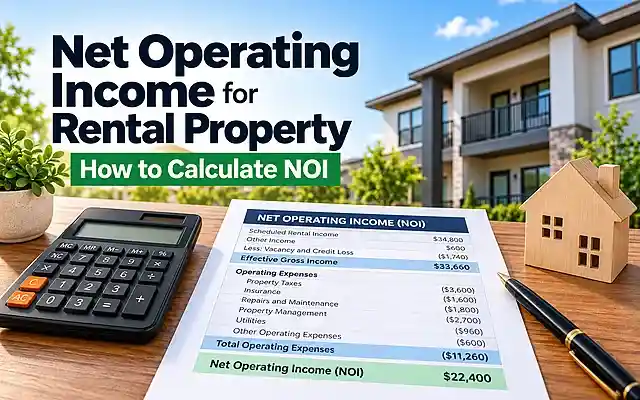
| Input | Base-case assumption |
|---|---|
| Purchase price | $320,000 |
| Monthly scheduled rent | $2,900 |
| Scheduled annual rent | $34,800 |
| Other recurring income | $600 per year |
| Vacancy and credit loss | 5% of scheduled rent |
| Effective gross income | $33,660 |
The 5% vacancy assumption is used only for this example. It is not a universal vacancy recommendation.
Step 1: Calculate effective gross income
Scheduled annual rent: $2,900 × 12 = $34,800
Other recurring income: $600
Hypothetical vacancy and credit loss: $34,800 × 5% = $1,740
Effective gross income: $34,800 + $600 – $1,740 = $33,660
Step 2: Subtract operating expenses
Assume these hypothetical annual expenses:
| Operating expense | Annual assumption |
|---|---|
| Property taxes | $3,600 |
| Insurance | $1,600 |
| Routine maintenance | $1,800 |
| Property management | $2,700 |
| Owner-paid utilities | $960 |
| Licensing / recurring administration | $600 |
| Total operating expenses | $11,260 |
Every expense is an example input. A real property may have different categories and materially different amounts.
Step 3: Calculate NOI
NOI = $33,660 – $11,260
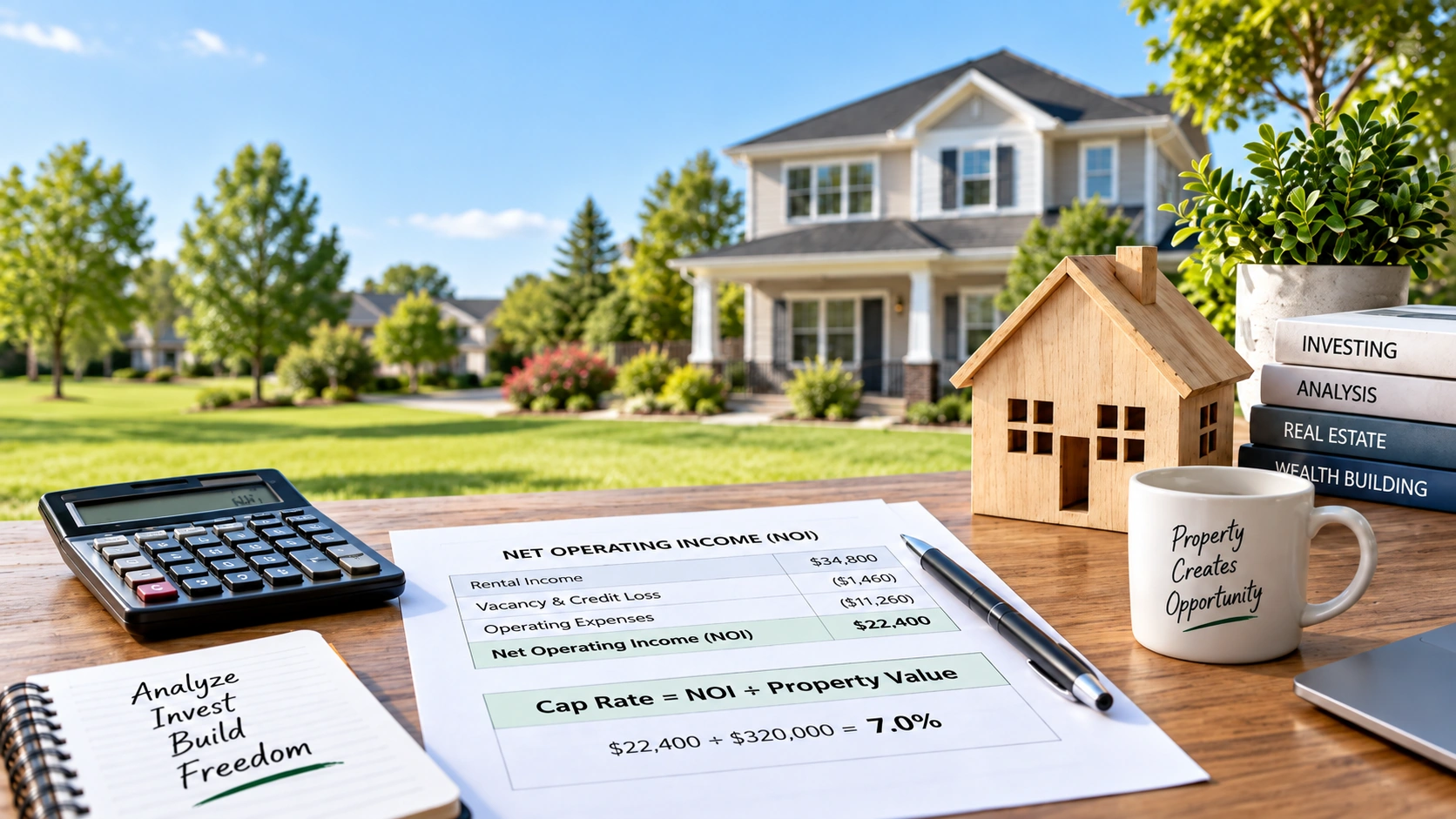
NOI = $22,400
Step 4: Calculate cap rate
Cap Rate = $22,400 / $320,000 × 100
Cap Rate = 7.0%
The hypothetical rental property cap rate is therefore 7.0% at a $320,000 purchase price using the stated NOI assumptions.
That percentage is not an investment verdict. It is one property-level metric that still needs to be interpreted alongside the quality of the income assumptions, condition, market, financing, liquidity, and other risks.
Purchase Price vs. Current Value: Why the Denominator Matters
Cap rate can change even when the property’s operations do not. Return to the hypothetical property with $22,400 of annual NOI.
At the $320,000 purchase price:
$22,400 / $320,000 = 7.0%
Now assume that, at a later point, the property’s supportable current market value is $350,000 while NOI is still $22,400.
Using current value:
$22,400 / $350,000 = 6.4%
Nothing about the property’s NOI changed. The denominator changed. That is why it is important to distinguish:
- acquisition cap rate using the price being evaluated;
- yield on historical cost when current NOI is divided by the original acquisition cost; and
- current cap rate using current market value.
Those calculations can answer different questions and should not be labeled interchangeably.
For an acquisition, purchase price is usually the natural denominator because it is the amount being evaluated.
For an existing holding, current value can be more useful when comparing the property’s present income yield with the value of the capital tied up in the asset.
What Is a Good Cap Rate for Rental Property?
There is no universal cap rate that is “good” for every rental property. A useful cap rate has to be interpreted in context.
Factors that can affect the meaning of a cap rate include:
- local market pricing;
- property type;
- neighborhood or submarket;
- property condition;
- quality and durability of rental income;
- vacancy and collection risk;
- expense assumptions;
- expected capital expenditures;
- management intensity;
- liquidity;
- growth expectations; and
- the pricing of comparable income-producing properties.
A 7% cap rate in one market does not automatically mean the same thing as a 7% cap rate in another.
It also does not mean two properties with the same cap rate have the same risk, growth prospects, physical condition, or future cash needs.
A higher cap rate is not automatically better
A higher cap rate can mean the property produces more NOI relative to its price or value.
That can be attractive. It can also accompany factors such as:
- weaker property demand;
- greater location risk;
- more volatile income;
- deferred maintenance;
- higher operating uncertainty;
- shorter remaining economic life of major systems;
- less liquidity; or
- a price that reflects problems not visible in the simple formula.
The percentage should prompt further analysis, not replace it.
A lower cap rate is not automatically bad
A lower cap rate can reflect a higher price relative to NOI.
It may also reflect market pricing that assigns a premium to perceived stability, location quality, income durability, or liquidity.
That does not mean a lower cap rate is automatically acceptable.
The property still needs to meet the investor’s objectives, risk tolerance, financing constraints, and return requirements.
The key question is not whether the cap rate fits one national rule. It is whether the price, NOI, condition, market, and risk make sense together.
Listing Cap Rate vs. Buyer-Underwritten Cap Rate
A listing cap rate is only as useful as the NOI behind it.
A seller, broker, buyer, lender, or appraiser may use different assumptions when estimating income and expenses.
The percentage alone does not tell you whether the NOI includes realistic vacancy, management, insurance, repairs, taxes, utilities, or other costs.
That is why a buyer should rebuild the cap rate from the underlying numbers.
Hypothetical comparison
Suppose a property is offered at $320,000 and the listing materials show annual NOI of $25,600.
Listing cap rate: $25,600 / $320,000 = 8.0%
After reviewing the rent, vacancy, and operating expenses, the buyer develops a lower supported NOI of $22,400.
Buyer-underwritten cap rate: $22,400 / $320,000 = 7.0%
The property price did not change. The NOI assumption changed.
The one-percentage-point difference is meaningful because the formula did not change. The NOI assumptions did. The buyer is deciding which income and expense assumptions are credible.
Do not assume the seller’s NOI is wrong simply because your result is different. Reconcile the assumptions and determine why the numbers differ.
Cap Rate vs. Cash Flow
Cap rate and cash flow answer different questions.
Cap rate compares NOI with property price or value before financing.
Cash flow measures how much cash remains after the property-level economics are combined with financing and any other defined below-NOI cash requirements.
A property can have the same cap rate for two different buyers but very different cash flow if they use different loan amounts, interest rates, or amortization structures.
For the financing-dependent calculation, see Rental Property Cash Flow.
Cap Rate vs. Cash-on-Cash Return and ROI
Cap rate, cash-on-cash return, and ROI are related concepts, but they should not be used interchangeably.
Cap rate vs. cash-on-cash return
Cap rate uses: Annual NOI / Property Price or Value
Cash-on-cash return compares: Annual Pre-Tax Cash Flow / Investor Cash Invested
The major distinction is financing sensitivity. Cap rate is property-level under the convention used here.
Cash-on-cash return depends on how much cash the investor contributes and how financing changes annual cash flow.
That makes cash-on-cash return useful for a different question, but this article does not treat it as a substitute for cap rate.
Cap rate vs. ROI
ROI is a broader term.
Depending on the context, a return-on-investment calculation might include or exclude different sources of return, different time periods, financing, sale proceeds, appreciation, or other components.
Before comparing ROI with cap rate, define exactly what the ROI calculation includes.
Cap rate has a narrower property-income relationship: NOI / Price or Value
That narrower definition is one reason it can be useful for comparing income-producing properties on a more consistent property-level basis.
How Changes in NOI or Value Change the Cap Rate
Cap rate moves when either NOI or the selected price or value changes. The following table uses the hypothetical base case:
| Scenario | NOI | Price / Value | Cap Rate |
|---|---|---|---|
| Base case | $22,400 | $320,000 | 7.00% |
| Lower NOI | $20,000 | $320,000 | 6.25% |
| Higher NOI | $24,000 | $320,000 | 7.50% |
| Higher value | $22,400 | $350,000 | 6.40% |
| Lower value | $22,400 | $300,000 | 7.47% |
The table illustrates two different mechanisms.
If value stays constant, higher NOI raises the cap rate and lower NOI reduces it.
If NOI stays constant, a higher property value reduces the cap rate and a lower value raises it.
This is important because a high cap rate is not automatically evidence of a strong property. A high cap rate created by overstated NOI is unreliable.
A high cap rate created by a low market value may reflect a genuine pricing opportunity, but the lower value may also reflect property, location, income, liquidity, or risk issues that need investigation.
When Cap Rate Is Useful
Cap rate can be useful when it is applied to the right question. Common uses include:
- screening income-producing properties;
- comparing similar properties;
- checking the relationship between NOI and price;
- discussing value under a direct-capitalization framework;
- comparing an acquisition price with the income it is expected to support; and
- understanding how changes in NOI or value affect the income yield implied by the property.
Cap rate is most useful when:
- the NOI assumptions are supportable;
- the property is reasonably stabilized or the analyst clearly explains any stabilization assumptions;
- the denominator is clearly identified; and
- comparisons use similar property types, locations, time periods, and calculation conventions.
The OCC describes direct capitalization as converting stabilized NOI into value using an appropriate capitalization rate. That concept is useful for understanding why cap rate works best when income assumptions are supportable and reasonably representative rather than temporary or distorted. OCC Commercial Real Estate Lending
What Cap Rate Does Not Tell You
Cap rate is useful, but it does not answer every investment question.
By itself, it does not tell you:
- the mortgage payment;
- monthly or annual investor cash flow;
- the investor’s cash invested;
- cash-on-cash return;
- future appreciation or depreciation;
- tax consequences;
- the timing of major capital expenditures;
- multi-year returns;
- refinance proceeds;
- sale proceeds;
- transaction costs;
- whether the rent assumption is realistic;
- whether the expenses are complete; or
- whether the property fits the investor’s strategy.
A clean cap-rate calculation can still be built on poor assumptions. That is why the metric should be used inside a broader underwriting process rather than as a stand-alone decision rule.
Common Rental Property Cap Rate Mistakes
Using gross rent instead of NOI
Cap rate is not scheduled rent divided by price. The numerator should be an appropriate NOI under a clearly stated convention.
Ignoring vacancy or normal operating expenses can materially overstate the result.
Omitting vacancy and credit loss
A property that is not fully occupied or does not collect every scheduled dollar still has real income loss.
Assuming 100% collection without support can make NOI and cap rate look stronger than the economics justify.
Leaving out normal operating expenses
Property taxes, insurance, maintenance, management, owner-paid utilities, and other normal operating expenses can materially affect NOI.
A high cap rate produced by missing expenses is not a more attractive deal. It is an incomplete calculation.
Including mortgage payments in NOI
Mortgage principal and interest belong to financing under the convention used here.
Including them in NOI mixes property operations with investor financing and makes cap-rate comparisons less consistent.
Using inconsistent reserve conventions
Some analysts include replacement reserves in NOI while others treat them separately.
State the convention before comparing cap rates.
Using historical purchase price without labeling it
An owner’s yield on historical cost can be informative, but it is not the same measure as the property’s current cap rate when current market value is the denominator.
If the property’s value changed, identify whether you are calculating yield on historical cost or a current cap rate based on current value.
Accepting a listing cap rate without rebuilding the NOI
A published cap rate is a starting point, not a substitute for reviewing the income and expense assumptions.
Rebuild the NOI from the available evidence.
Comparing different markets or property types as though cap rates are interchangeable
A cap rate should not be interpreted without market and property context.
Properties with different locations, tenant profiles, physical condition, operating complexity, and liquidity can deserve different pricing relationships.
Assuming the highest cap rate is the best investment
A higher cap rate can reflect stronger income relative to price.
It can also reflect higher risk. Investigate the reason for the difference.
Using one national benchmark as a universal rule
There is no one cap-rate percentage that automatically makes every rental property attractive.
Use relevant market evidence and the property’s own economics.
Confusing cap rate with cash-on-cash return
Cap rate is based on NOI and property price or value.
Cash-on-cash return is based on investor cash flow and invested cash. They answer different questions.
Rental Property Cap Rate Checklist
Use this checklist when calculating or reviewing a rental property cap rate.
Income
- Confirm scheduled rent.
- Verify supportable other recurring income.
- Account for vacancy and credit loss.
- Calculate effective gross income.
Operating expenses
- Include property taxes.
- Include insurance.
- Include routine maintenance.
- Account for management.
- Include owner-paid utilities and recurring property-specific costs.
- State how reserves are treated.
NOI
- Calculate effective gross income minus operating expenses.
- Keep investor financing outside NOI.
- Check whether the NOI represents realistic, supportable operations.
Price or value
- Decide whether the calculation uses acquisition price, historical cost, or current market value.
- Label the denominator clearly.
- Avoid comparing cap rates that use different bases without recognizing the difference.
Interpretation
- Calculate the percentage accurately.
- Rebuild seller or listing assumptions when necessary.
- Compare with relevant property and market evidence.
- Review why the cap rate is higher or lower, not just the percentage itself.
- Analyze financing separately.
- Use cash flow and cash-on-cash return for financing-dependent questions.
- Test whether the result still makes sense if NOI weakens.
A rental property cap rate is most useful when both sides of the formula are credible. The percentage can help organize a decision, but it cannot rescue an overstated NOI or an unrealistic value assumption.
If the cap rate is only one part of a property you are underwriting, return to Rental Property Analysis for the complete decision process. If the next question is what remains after financing, continue with Rental Property Cash Flow.