Rental Property Maintenance Checklist: Preventive, Seasonal, and Turnover Tasks
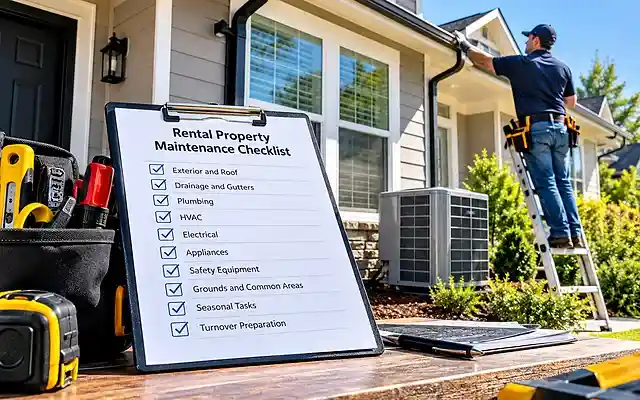
A rental property maintenance checklist should do more than remind a landlord that gutters, HVAC equipment, plumbing, alarms, and other property systems need attention.
Its real purpose is to create a repeatable maintenance process.
A useful checklist helps you answer six questions:
- What property area or system needs attention?
- What condition or event should trigger the task?
- Who is responsible for completing it?
- What evidence or documentation should be retained?
- Does the issue require follow-up?
- When should the property or system be reviewed again?
That structure matters because rental-property maintenance does not operate on one universal national schedule.
A single-family rental in a cold climate may have different needs from a small multifamily property in a hot, humid region.
Equipment design, age, manufacturer instructions, service agreements, occupancy conditions, local laws, and the property’s actual condition can all affect what needs to happen and when.
The goal is therefore not to memorize a generic calendar. It is to build a landlord maintenance checklist that makes preventive work, repair requests, seasonal preparation, turnover tasks, vendor coordination, and maintenance records visible before something gets forgotten.
What a Rental Property Maintenance Checklist Should Do
Maintenance has several different functions.
Some work is preventive. You are trying to identify or address a developing condition before it becomes a larger problem.
Some work is reactive. A tenant reports a leak, an appliance stops working, an alarm activates, or a system develops a fault. Some work is tied to a transition, such as a turnover.
Other work becomes necessary because of weather, an inspection finding, a manufacturer’s requirement, a service plan, or an applicable legal obligation.
A strong rental property maintenance checklist should connect all of those situations to the same operating system.
That means the checklist should cover:
- prevention;
- issue reporting;
- triage;
- assignment;
- access coordination;
- repair or service;
- documentation;
- completion verification;
- recurring-problem review; and
- the next appropriate maintenance trigger.
This article focuses specifically on that maintenance execution layer.
For the broader system covering tenant communication, records, rent collection, compliance, renewals, turnovers, maintenance, and other operating responsibilities, use the Landlord Operations guide.
Keep the Checklist Focused on the Property
A landlord maintenance checklist is not a tenant housekeeping checklist.
The maintenance system should focus on matters such as property condition, supplied equipment, building systems, inspections, repair requests, preventive service, vendor coordination, work orders, and maintenance records.
Lease provisions may assign certain routine responsibilities to tenants where legally permitted, but that does not turn a property-maintenance system into a list of household cleaning instructions.
The central question is whether the property and its systems are being monitored, maintained, repaired, documented, and followed up appropriately.
Build the Maintenance Calendar Around Triggers, Not a Universal Schedule
One of the easiest ways to build a weak maintenance program is to copy a generic calendar and assume every item should happen at the same interval for every rental.
A better system starts with the reason a task needs to occur.
| Trigger / Cadence Basis | What It Means | Examples |
|---|---|---|
| Turnover | Work connected to the end of one tenancy and preparation for the next | Condition review, unresolved work orders, supplied appliances, maintenance baseline |
| Seasonal / climate-dependent | Work prompted by weather exposure or seasonal property conditions | Freeze preparation, storm readiness, drainage, vegetation, cooling or heating preparation |
| Manufacturer / service-plan | Work based on equipment instructions, warranties, filters, service agreements, or professional guidance | HVAC filters, equipment servicing, alarm instructions, appliance maintenance |
| Inspection / condition-based | Work identified during a lawful property-condition review | Leak evidence, exterior deterioration, drainage problems, unsafe conditions |
| Event-driven | Work triggered by something that happened at the property | Tenant report, storm, leak, outage, equipment fault, water intrusion |
| Jurisdiction-required | Work or inspection required by applicable law, code, housing program, or local requirement | Location-specific safety, inspection, maintenance, or property-standard requirements |
The same task can also have more than one trigger.
For example, an HVAC system may need attention because the manufacturer recommends service, because a tenant reports a problem, because a turnover inspection identifies an issue, or because a seasonal change makes system readiness more important.
That is more useful than assuming every HVAC system, roof, water heater, alarm, or plumbing component belongs on the same fixed national timetable.
Legal obligations also vary by location. Repair duties, inspection procedures, property-entry requirements, and other landlord responsibilities can depend on state or local law and the lease.
For jurisdiction-specific tenant and landlord information, start with the appropriate state resources listed through USA.gov tenant-rights guidance and then verify the actual law that applies to the property.
Life-Safety and Immediate-Risk Checks
Life-safety items deserve a distinct place in the maintenance system because some conditions should not enter the same queue as ordinary cosmetic work.
The exact requirements depend on the property and jurisdiction, but a landlord’s system may need to account for:
- smoke alarms where required;
- carbon monoxide alarms where applicable;
- fuel-burning equipment concerns;
- reported electrical or fire hazards;
- unsafe stairs, railings, walking surfaces, or other physical hazards;
- required egress conditions;
- major water intrusion;
- serious heating or cooling failures where safety or habitability may be affected; and
- other location-specific safety requirements.
The checklist should distinguish between a safety recommendation and a legal requirement.
For example, the U.S. Consumer Product Safety Commission publishes carbon monoxide safety guidance covering fuel-burning equipment and CO risks.
That safety guidance is useful when building operating procedures, but landlords should still verify the alarm, installation, inspection, and maintenance requirements that apply in their jurisdiction and follow the manufacturer’s instructions for the devices installed at the property.
The maintenance record should identify the actual device or system, what was checked, what instructions or legal requirement controlled the task, what action was taken, and whether follow-up is still required.
Do not rely on a generic checklist entry that simply says “alarms checked” with no record of what that means.
Core Rental Property Maintenance Checklist by System
A practical checklist should organize maintenance around the property systems that can create operational, safety, water, comfort, or asset-condition problems.
The exact list will vary by property.
| System / Area | What to Monitor | Trigger Basis | Typical Follow-Up |
|---|---|---|---|
| Exterior and roof | Exterior condition, visible roof concerns, doors, windows, weather exposure | Condition, storm, turnover, seasonal | Inspect further, document, assign qualified service where needed |
| Drainage | Gutters/downspouts where present, grading, standing water, discharge paths | Rain, storm, seasonal, inspection | Correct blockage or drainage issue and recheck |
| Plumbing | Active leaks, fixtures, visible supply/drain concerns, shutoff access | Tenant report, inspection, event | Stop or control damage where possible, assign service, verify repair |
| Moisture | Water intrusion, dampness, repeated condensation, staining | Leak, storm, inspection, recurrence | Find source, correct water entry, document drying and follow-up |
| HVAC | Filters, condensate drainage, controls, reported faults, service needs | Manufacturer, service plan, operating condition, seasonal | Service or repair according to equipment requirements |
| Electrical | Reported faults, visible damage, unsafe conditions | Tenant report, inspection, event | Escalate unsafe conditions and use qualified service |
| Supplied appliances | Reported faults, visible deterioration, operating problems | Tenant report, turnover, manufacturer guidance | Diagnose through appropriate service and document outcome |
| Grounds / common areas | Walkways, lighting, drainage, vegetation, shared areas | Condition, weather, lawful inspection | Correct applicable hazards or maintenance issues |
| Safety equipment | Applicable smoke/CO devices and other required safety systems | Law, manufacturer, turnover, event | Test, service, replace, or escalate as applicable |
Exterior, Roof, and Drainage
Water should move away from the building rather than into it.
That makes the exterior envelope and drainage system important maintenance categories even when there is no obvious interior problem.
Depending on the property, review items such as:
- visible exterior deterioration;
- roof conditions that can be observed safely;
- gutters and downspouts where present;
- discharge locations;
- grading;
- standing water;
- doors and windows;
- exterior penetrations;
- weather-related damage; and
- repeated areas of water entry.
The checklist should not encourage landlords to climb onto roofs or perform technical inspections they are not qualified to conduct.
If a condition requires specialized access or evaluation, assign the work to an appropriate professional and document the result.
Plumbing, Water, and Moisture
Water problems should be highly visible in a maintenance system.
Track:
- active leaks;
- recurring leaks;
- dripping or malfunctioning fixtures;
- visible supply or drain problems;
- shutoff accessibility;
- water staining;
- damp materials;
- recurring condensation;
- roof or exterior water entry;
- plumbing-related moisture; and
- HVAC condensate problems.
EPA’s moisture-control guidance addresses drainage, roofing and building assemblies, plumbing, HVAC systems, and preventive maintenance as parts of building moisture control.
The useful operating principle is simple: do not treat repeated moisture as an isolated cosmetic problem.
A recurring stain, leak, wet area, or condensation problem should trigger investigation of the source, documentation of the work performed, and a follow-up check where appropriate.
The maintenance record should make it possible to see whether the same area has failed before.
HVAC and Ventilation
HVAC maintenance should be tied to the actual equipment, not a copied calendar.
The checklist may need to track:
- filter requirements;
- filter type and size;
- condensate drainage;
- thermostat or control issues;
- unusual operating problems;
- heating or cooling complaints;
- fuel-burning equipment concerns;
- service-plan requirements;
- manufacturer maintenance instructions; and
- qualified professional service.
ENERGY STAR publishes a general heating and cooling maintenance checklist, but a landlord should still build the property calendar around the installed equipment, actual filter, operating conditions, manufacturer instructions, service agreement, and professional recommendations.
Do not convert a general recommendation into a mandatory interval for every rental property.
If several properties use different HVAC systems, each property record should identify which instructions apply to which equipment.
Electrical Systems and Supplied Appliances
Electrical work is not an appropriate place for a landlord article to become a DIY repair manual.
The maintenance system should instead make problems visible and route technical work appropriately.
Track matters such as:
- reported loss of power;
- repeatedly malfunctioning circuits or fixtures;
- damaged electrical components that are safely observable;
- burning, overheating, sparking, or other reported unsafe conditions;
- supplied-appliance faults;
- appliance leaks;
- unusual equipment behavior; and
- repeated service calls.
Unsafe or technical electrical problems should be escalated to qualified service.
The maintenance record should show what was reported, who evaluated it, what work was performed, and whether the issue was resolved.
Grounds, Common Areas, and Property-Specific Systems
Not every property needs the same grounds or common-area checklist.
A single-family rental may involve exterior lighting, walkways, vegetation, drainage, fencing, or other site conditions.
A small multifamily property may add:
- shared stairs;
- common corridors;
- shared exterior areas;
- common lighting;
- shared utility areas;
- common entrances; and
- other property-specific systems.
Weather can also create temporary hazards, such as storm debris, ice, drainage problems, or vegetation issues.
Include only the items that actually exist at the property.
Seasonal and Climate-Based Maintenance
Seasonal maintenance is useful when it is based on the climate and building, not when it becomes a national checklist copied without context.
Ask what changes at this property when local weather changes.
Depending on location and building design, the maintenance plan may need to consider:
- freezing temperatures;
- extreme heat;
- heavy rain;
- storm exposure;
- snow or ice;
- vegetation growth;
- drainage conditions;
- wildfire-related exposure;
- seasonal HVAC use; or
- periods when the property is more vulnerable to moisture.
A cold-weather property may require preparation that is irrelevant to a warm-weather rental.
A humid region may place greater emphasis on drainage, ventilation, condensation, and moisture monitoring.
A storm-prone area may require a different pre-event and post-event property review.
The checklist should therefore identify:
Trigger: What climate or seasonal condition makes the task relevant?
Action: What needs to be checked or coordinated?
Evidence: What record confirms the task occurred?
Follow-up: Does anything need repair, professional evaluation, or another review?
That creates a seasonal maintenance system without pretending every U.S. rental needs the same seasonal calendar.
Turnover Maintenance Checklist
Turnover creates a useful opportunity to establish a clean maintenance baseline.
The objective is not merely to make the unit look ready for a new tenant. It is to identify unresolved property issues before the next tenancy begins.
This maintenance checklist addresses property readiness, not how possession is legally obtained. If a landlord and tenant are negotiating a voluntary move-out in exchange for compensation, our Cash for Keys Agreement guide explains the separate agreement, payment and tenant-rights considerations.
A turnover maintenance checklist may include:
- document the property’s current condition;
- review unresolved maintenance requests;
- verify that open work orders are actually complete;
- check applicable smoke and carbon monoxide devices;
- look for active or historical water intrusion;
- review plumbing fixtures and visible water-related conditions;
- review HVAC operation and any outstanding service items;
- check supplied appliances;
- review doors, windows, locks, and property-specific exterior items;
- coordinate repair and cleaning handoffs;
- retain relevant photos, notes, invoices, and work-order records; and
- establish the next maintenance triggers for the new tenancy.
A turnover is also a useful time to compare the property with the previous baseline.
If the same maintenance problem appears at multiple turnovers, that can be more informative than treating each occurrence as a new event.
Inspections, Access, and Maintenance Discovery
A landlord cannot maintain a property effectively if developing conditions are never discovered.
Property-condition reviews can help identify:
- water intrusion;
- deferred repairs;
- visible system problems;
- exterior deterioration;
- unsafe conditions;
- unresolved tenant reports; and
- work that should be scheduled.
But the maintenance purpose does not create unlimited access to an occupied rental.
Notice requirements, permitted reasons for entry, inspection procedures, and lease provisions vary by jurisdiction.
Do not choose an inspection frequency because another landlord uses it.
Instead, establish a lawful process that answers:
- What legitimate property condition needs to be reviewed?
- What does the lease permit?
- What notice is required?
- Does state or local law impose additional rules?
- What maintenance condition was discovered?
- What follow-up is required?
- What record should be retained?
The maintenance calendar can then use lawful inspection findings as one of several maintenance triggers.
Triage Maintenance Requests Without Inventing Legal Deadlines
Not every maintenance request belongs in the same queue.
A useful internal triage system separates operational urgency without pretending to define the legal deadline for every jurisdiction.
| Internal Triage Level | Maintenance Trigger | Required Next Action | Closeout Control |
|---|---|---|---|
| Routine | Minor non-safety defect or ordinary maintenance item | Record the issue, assign responsibility, and schedule appropriate evaluation or service | Confirm completion and retain the relevant work-order record |
| Time-sensitive | Active but contained leak, important equipment fault, or condition likely to worsen | Escalate for prompt evaluation or service and document access or vendor coordination | Confirm the condition was corrected and schedule a recheck where appropriate |
| Potential emergency / immediate escalation | Significant water intrusion, reported fire/electrical hazard, CO concern, dangerous condition, or major system failure affecting safety | Use the property’s emergency process and appropriate emergency or qualified professional resources | Document the escalation and do not close the record until the immediate condition and required follow-up have been addressed |
These are internal operating categories, not legal definitions. A state or locality may impose duties that are different from the landlord’s internal classification.
The point of the triage system is to stop a serious issue from sitting unnoticed in the same queue as a low-consequence repair.
What Should Trigger Immediate Escalation?
A maintenance system should have a clear route for high-consequence conditions.
Examples may include:
- active water entering the building;
- reported electrical or fire hazards;
- a carbon monoxide alarm or suspected CO concern;
- unsafe structural or access conditions;
- a major building-system failure affecting safety;
- significant weather damage; or
- another condition that creates an immediate risk to people or property.
The landlord’s job is not to diagnose every technical problem personally.
The operating responsibility is to recognize that the issue requires escalation, use appropriate emergency or professional resources, document what happened, and follow through.
Build the Maintenance Log and Work-Order Record
A checklist tells you what needs attention. A maintenance log tells you what actually happened.
Without a reliable log, landlords can lose the history of recurring leaks, repeated service calls, vendor callbacks, appliance failures, inspection findings, and unfinished work.
At minimum, the maintenance record should capture:
- property and unit;
- date reported or discovered;
- source of the report;
- issue description;
- internal triage level;
- tenant contact and access history where relevant;
- assigned person or vendor;
- authorized scope of work;
- work performed;
- notes, photos, or other evidence where appropriate;
- invoice or cost reference;
- status;
- unresolved follow-up;
- closeout date; and
- next review or maintenance trigger where appropriate.
The invoice reference belongs in the maintenance record because it helps reconstruct what happened.
That does not mean the maintenance article should become an expense-budgeting article. For expense categories, operating-cost estimates, and budgeting, use the Rental Property Expenses guide.
What Should a Work Order Contain?
A useful work order should make the requested job clear enough that the landlord, vendor, tenant, or manager is not working from different versions of the problem.
Include:
- property and unit;
- issue description;
- scope or requested evaluation;
- authorization;
- assigned vendor or responsible person;
- access instructions;
- tenant contact information where appropriate;
- relevant photos or supporting information;
- status;
- completion evidence; and
- any unresolved follow-up.
Avoid vague instructions such as “fix plumbing” when the actual issue is known. A clearer work order creates a better completion record.
Rental Property Maintenance Log Template
Use a separate maintenance-log entry for each reported, discovered, or scheduled maintenance event.
| Date | Property / Unit | Issue or Trigger | Triage Level | Assigned To | Work Performed / Evidence | Status / Follow-Up |
|---|---|---|---|---|---|---|
| Example | Property or unit identifier | Reported leak, inspection finding, turnover item, equipment fault, or other trigger | Routine / Time-sensitive / Potential emergency | Owner, manager, or vendor | Work order, completion notes, invoice reference, photos where appropriate | Open, complete, recheck required, or recurring issue |
Use one row for each maintenance event so the record shows what triggered the work, who handled it, what was completed, what evidence was retained, and whether another action is still required.
Vendor and Follow-Up Workflow
A repair is not complete simply because a vendor visited the property. The maintenance system needs a closeout process.
A practical workflow is:
- Identify the issue. Record what was reported or discovered.
- Assign the work. Use an appropriate vendor or responsible person and verify required credentials or insurance where applicable.
- Define the scope. Clarify what is being evaluated or repaired and how access will be handled.
- Document completion. Record what was actually done and retain relevant invoices, notes, photos, or service records.
- Verify and follow up. Confirm whether the problem is resolved, whether a callback is needed, and whether another review should be scheduled.
Do Not Close Work Orders Automatically
A status of “vendor completed” does not always mean the underlying issue is resolved.
Before closing a work order, ask:
- Was the requested work actually completed?
- Did the original symptom stop?
- Is another trade required?
- Does the area need rechecking?
- Is documentation complete?
- Did the vendor identify a larger underlying issue?
- Should the property calendar contain a new follow-up trigger?
This becomes especially important when the same issue appears repeatedly.
Use Maintenance History to Improve the System
Maintenance records should become more valuable over time.
A single repair tells you what happened once. Repeated repairs can reveal a pattern.
Examples might include:
- recurring water staining in the same area;
- repeated drain backups;
- repeated HVAC shutdowns;
- recurring appliance failures;
- recurring exterior water entry;
- multiple callbacks after the same repair; or
- repeated problems associated with the same system.
When that happens, stop treating each work order as an isolated event. Review the maintenance history.
Ask:
- Is the same symptom recurring?
- Has the underlying source actually been identified?
- Are repairs addressing the cause or only the visible result?
- Does a qualified professional need to evaluate the broader system?
- Is replacement or a larger corrective project now relevant?
- Does the maintenance calendar need a different trigger?
The objective is not to diagnose technical failures without expertise. It is to make recurring failure visible enough that the landlord can make a better operating decision.
Pre-1978 Lead-Safe Maintenance
Older rental properties require an additional control when repair or maintenance work can disturb painted surfaces.
EPA’s Renovation, Repair and Painting Program can apply to covered renovation, repair, and painting work in pre-1978 housing.
EPA explains that paid work disturbing painted surfaces can trigger RRP requirements and specifically identifies residential rental property owners and managers among the firms that may be covered.
EPA’s contractor guidance identifies residential rental property owners/managers among the firms that can be covered and lists repair and maintenance, electrical work, plumbing, painting preparation, carpentry, and window replacement among activities that can fall within the rule when its requirements apply.
That means lead-safe compliance should be considered before covered work begins, not after demolition or paint disturbance has already occurred.
For a pre-1978 rental:
- determine whether the planned work falls within the RRP rule;
- identify who will perform it;
- verify applicable certification and work-practice requirements;
- check whether the property is in an EPA-authorized state or tribal program;
- retain relevant documentation; and
- do not assume that an ordinary maintenance label removes lead-safe obligations.
The EPA rule does not create a general contractor-licensing standard for every trade. Contractor licensing and similar requirements can be governed separately by state or local law.
Rental Property Maintenance Checklist Template
The most useful checklist is one that can be reused for a single property and adapted as a portfolio grows.
Use a structure like this:
| System / Area | Task | Trigger / Cadence Basis | Responsible Party | Evidence / Work Order | Status / Follow-Up |
|---|---|---|---|---|---|
| Exterior | Review visible exterior condition | Turnover, storm, seasonal, condition | Owner / manager / qualified vendor | Notes, photos, work order | Open / closed / follow-up |
| Drainage | Check applicable drainage paths and standing-water concerns | Rain event, seasonal, inspection | Owner / manager / vendor | Notes, photos | Recheck after correction |
| Plumbing | Investigate reported leak | Event-driven | Plumber / maintenance provider | Work order, invoice, completion notes | Verify leak resolved |
| Moisture | Review recurring dampness or staining | Event, inspection, recurrence | Appropriate qualified professional | Photos, notes, service record | Root-cause follow-up |
| HVAC | Review filters or service requirement | Manufacturer, equipment, service plan | Owner / HVAC professional | Model info, service record | Set next equipment-specific trigger |
| HVAC condensate | Check reported or observed drainage issue | Condition, service, event | HVAC professional | Work order, notes | Confirm drainage restored |
| Electrical | Escalate reported unsafe fault | Event-driven | Qualified electrical professional | Work order, service record | Verify resolution |
| Supplied appliance | Address operating fault | Tenant report, turnover, manufacturer | Appliance service / responsible party | Work order, invoice | Close or recheck |
| Safety equipment | Confirm applicable devices and functionality | Law, manufacturer, turnover, event | Responsible qualified party | Test/service record | Follow applicable instructions |
| Grounds / common areas | Review property-specific hazards | Weather, inspection, condition | Owner / manager / vendor | Notes, photos | Correct and verify |
The trigger column is the most important part of the template.
Do not fill it with arbitrary intervals simply because a spreadsheet expects a date.
Instead, use the controlling basis:
- turnover;
- local season or climate;
- manufacturer instruction;
- service agreement;
- lawful inspection;
- tenant report;
- equipment fault;
- storm or water event;
- applicable legal requirement; or
- another property-specific condition.
Build a Maintenance Calendar From the Checklist
Once the checklist exists, translate applicable tasks into a maintenance calendar.
Each calendar item should identify:
Property: Which rental or unit does this apply to?
System: What system or area is being monitored?
Trigger: Why is this task due?
Responsible party: Who owns the next action?
Evidence: What will prove the task was completed?
Status: Is it open, scheduled, complete, or waiting on follow-up?
Next trigger: When or under what condition should it return to the calendar?
This structure works whether you use a spreadsheet, property-management system, task manager, or another recordkeeping method.
The tool matters less than making sure important work cannot disappear.
Common Rental Property Maintenance System Mistakes
Relying on Memory
Maintenance becomes unreliable when important follow-up exists only in someone’s head.
Put recurring tasks, reported issues, work orders, and callbacks into a visible system.
Using One Generic National Calendar
A copied schedule may be too frequent for one system, inadequate for another, or completely irrelevant to the property’s climate and equipment.
Build cadence from actual triggers.
Treating Every Request as the Same Urgency
A cosmetic issue and active water intrusion should not enter the same operating queue.
Use an internal triage framework and separately verify applicable legal duties.
Closing Work Orders Without Verification
A vendor visit is not the same as a confirmed repair.
Document what was done and whether the original problem was actually resolved.
Losing Invoices, Photos, and Completion Notes
A maintenance record becomes much less useful when the history cannot be reconstructed.
Keep evidence connected to the property, issue, and work order.
Repeatedly Repairing Symptoms Without Reviewing the Pattern
A recurring problem deserves a history review.
Repeated callbacks may indicate that the root cause has not been addressed.
Mixing Maintenance Execution With Expense Budgeting
The maintenance system should retain invoice and cost references, but its purpose is execution and documentation.
Use the Rental Property Expenses guide for budgeting, cost categorization, and underwriting treatment.
Copying Another Landlord’s Legal Deadline or Entry Procedure
A repair-response deadline, entry procedure, inspection practice, or notice period used in another location may not apply to your property.
Verify the rules governing the actual jurisdiction and tenancy.
Final Thoughts
A good rental property maintenance checklist is not a promise that nothing will break.
Rental properties contain systems that wear, fail, leak, age, and respond differently to weather, occupancy, equipment design, and use.
The objective is to make maintenance predictable enough that important work does not depend on memory.
Build the checklist around the property’s actual systems. Use manufacturer, service-plan, climate, condition, turnover, event, inspection, and legal triggers instead of one generic national timetable.
Give serious issues a clear escalation path.
Document maintenance requests, access, work orders, vendor activity, completion evidence, and follow-up.
Review recurring failures as patterns instead of treating every service call as an isolated event.
Then use the maintenance history to improve the system over time.
This checklist supplies the execution layer: what needs attention, what triggered it, who owns the next step, what happened, and whether the issue is actually closed.